Civilization
Carthage
Also known as: Qart-ḥadašt, Karkhēdṓn, Carthāgō, Qarṭājanna
Carthage was the greatest of the Phoenician colonies, founded by settlers from Tyre on the North African coast at the Gulf of Tunis, traditionally in 814 BCE. From a trading post it grew into the dominant maritime power of the western Mediterranean, commanding a network of ports and colonies across North Africa, Sardinia, Sicily, and Spain, until its long contest with Rome in the three Punic Wars ended in its destruction in 146 BCE. Its people spoke Punic, the western dialect of Phoenician, and carried the Canaanite language and gods a thousand miles from their Levantine homeland.
Carthage is named, across every language, by one Phoenician phrase. The colonists called their city Qart-ḥadašt, “New City,” to set it apart from old Tyre, and that name is the root of all the others: the Greeks rendered it Karkhēdṓn, the Romans reshaped the Greek into Carthāgō, and Arabic, after the Muslim conquest of the region, took the Latin into Qarṭāj. So unlike its mother-cities, whose Greek name “Phoenicia” was an outsider’s invention, Carthage carried its own self-given name into every tongue that spoke of it, merely worn smooth by each retelling. The Hebrew Bible, which never names the city, is the one notable absence; only later did the Greek translators of Isaiah render the mysterious Tarshish as Karkhēdṓn, reaching for the most famous western port they knew.
Spot an error or have a suggestion? Send feedback ↓
Name families
Cognate names grouped by shared root. An indented name is borrowed from the form above it; names at the same level are parallel descendants.
The Qart-ḥadašt family
The Punic self-name of Carthage, "New City," carried into Greek as Karkhēdṓn, Latin as Carthāgō, and Arabic as Qarṭāj — the modern "Carthage." Every later form descends from the one Phoenician name.
Transmission map
Each form at the homeland of its language; arcs follow asserted borrowing paths. Slide to a year to see which names were in use.
in use at this year · formerly in use · not yet attested
✦ Carthage, the heartland
Attestation timeline
When each name is attested, earliest first. Dates bound the name's use, not the language's lifespan.
Names across languages
Phoenician c. 814 BCE – 146 BCE #
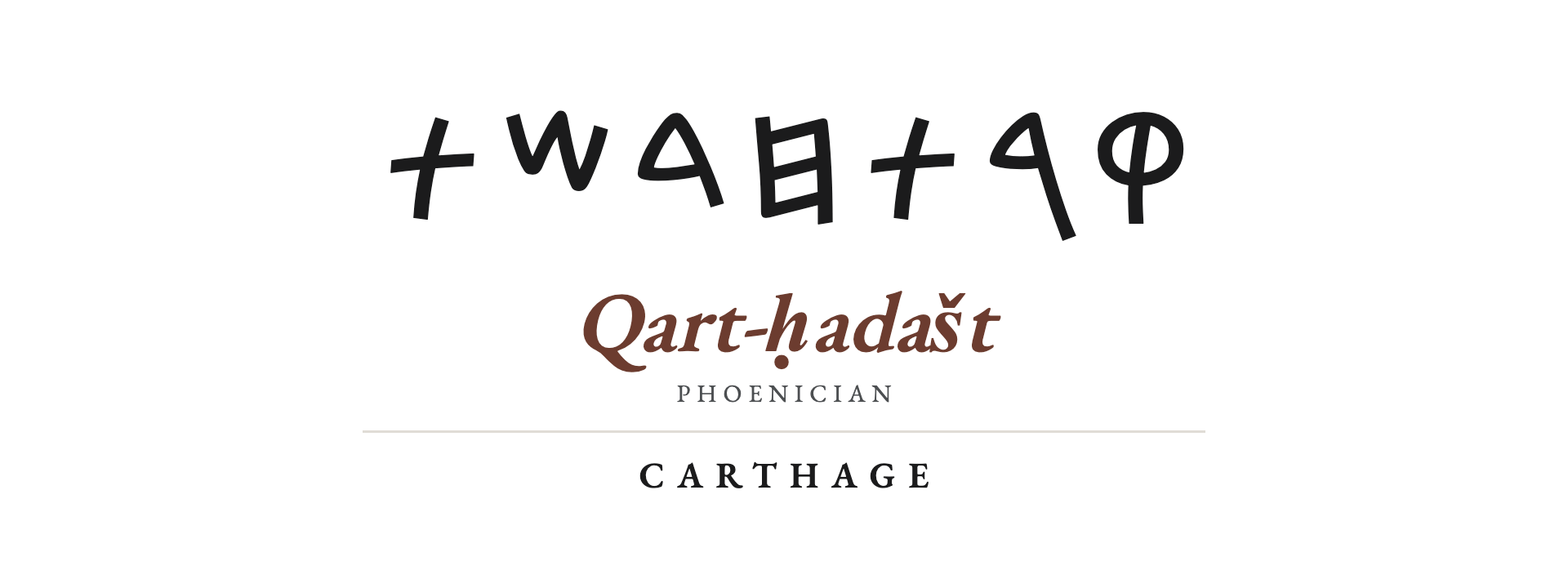
𐤒𐤓𐤕𐤇𐤃𐤔𐤕
- Transliteration
- Qart-ḥadašt
- IPA
- *qart ħaˈdaʃt
- Meaning
- “New City”
- Confidence
- attested
The Punic name of Carthage, Qart-ḥadašt, written qrt-ḥdšt in the consonantal Phoenician alphabet and meaning simply “New City.” It is qart, “city, town,” the same word in the names of other Phoenician foundations, joined to ḥadašt, the feminine of “new.” The settlers from Tyre gave it to distinguish their new colony from the older towns of the coast, perhaps from nearby Utica, whose own name meant “Old Town,” or from Tyre itself, the mother-city left behind. The name appears on Carthaginian coins and inscriptions and was borne by more than one Phoenician colony; the great one on the Gulf of Tunis simply became, to history, the New City.
Qart-ḥadašt is the headwater from which every other name on this page flows, and it makes Carthage the mirror image of its mother-country. Where the Phoenicians of the Levant are known by the Greek outsider-name “Phoenicia” and called themselves something else entirely, Carthage carried its own plain self-description into the wider world: the Greeks heard qart-ḥadašt and wrote Karkhēdṓn, the Romans took that and made Carthāgō, and Arabic later turned the Latin into Qarṭāj. Each language wore the consonants smoother, but the name that the world still uses for Rome’s great rival is, at bottom, two Phoenician words a band of colonists chose for a fresh start on a foreign shore: the New City.
Sources (2)
- Krahmalkov, Charles R. Phoenician-Punic Dictionary. Leuven: Peeters, 2000, s.v. qrt, ḥdš.
- Huss, Werner. Geschichte der Karthager. Munich: C. H. Beck, 1985.
Cite this entry
Rajagopal, Shriram. "Qart-ḥadašt (Phoenician name for Carthage)." Onomastikon: A Digital Atlas of Ancient Names. https://onomastikon.org/civilizations/carthage#phoenician-qarthadasht.
@misc{onomastikon-carthage-phoenician-qarthadasht, author = {Rajagopal, Shriram}, title = {Qart-ḥadašt (Phoenician name for Carthage)}, year = {2026}, howpublished = {\url{https://onomastikon.org/civilizations/carthage#phoenician-qarthadasht}}, note = {Onomastikon: A Digital Atlas of Ancient Names} }Ancient Greek c. 550 BCE – 400 CE #
Καρχηδών
- Transliteration
- Karkhēdṓn
- IPA
- /kar.kʰɛːˈdɔːn/
- Meaning
- “Carthage (from Punic Qart-ḥadašt)”
- Derived from
- Phoenician Qart-ḥadašt
- Confidence
- attested
The Greek name for Carthage, Karkhēdṓn, the Greeks’ rendering of Punic Qart-ḥadašt into the sounds of their own language. It is the form in Herodotus and Thucydides, who knew the Carthaginians as a great western sea-power, allies of the Persians and rivals of the Greeks of Sicily; the adjective Karkhēdónios, “Carthaginian,” runs through Greek historiography of the western Mediterranean. The Greeks compressed the four-syllable Phoenician phrase into a single word, keeping its skeleton of consonants while reshaping the vowels and the ending to Greek shape.
Karkhēdṓn is the crucial middle link of the chain, the form through which a Phoenician name reached the classical world and, by way of Rome, the modern one. The Latin Carthāgō is built not directly on the Punic but on this Greek intermediary, so that the modern “Carthage,” through Latin, is at one further remove a Greek reshaping of Qart-ḥadašt. The Greek form also did duty beyond the city itself: when the translators of the Septuagint reached the obscure place-name Tarshish in Isaiah, they reached for Karkhēdṓn, the grandest western port they could name, so that for a moment in the Greek Bible Carthage stood in for the unknown edge of the world.
Sources (2)
- Liddell, Henry George, and Robert Scott. A Greek-English Lexicon (LSJ). 9th ed. Oxford: Clarendon Press, 1940, s.v. Καρχηδών.
- Herodotus, Histories 1.166–167, 7.165–167; Thucydides, Histories 6.2, 6.34.
Cite this entry
Rajagopal, Shriram. "Karkhēdṓn (Ancient Greek name for Carthage)." Onomastikon: A Digital Atlas of Ancient Names. https://onomastikon.org/civilizations/carthage#ancient-greek-karkhedon.
@misc{onomastikon-carthage-ancient-greek-karkhedon, author = {Rajagopal, Shriram}, title = {Karkhēdṓn (Ancient Greek name for Carthage)}, year = {2026}, howpublished = {\url{https://onomastikon.org/civilizations/carthage#ancient-greek-karkhedon}}, note = {Onomastikon: A Digital Atlas of Ancient Names} }Latin c. 300 BCE – 600 CE #
Carthāgō
- Transliteration
- Carthāgō
- IPA
- /karˈtʰaː.goː/
- Meaning
- “Carthage (from Greek Karkhēdṓn, ultimately Punic Qart-ḥadašt)”
- Derived from
- Ancient Greek Karkhēdṓn
- Confidence
- attested
The Latin name for Carthage, Carthāgō, reshaped from the Greek Karkhēdṓn into a Latin third-declension noun. It is among the most heavily freighted place-names in Latin literature: the city of Hannibal and the Punic Wars, the Carthāgō that Cato the Elder insisted “must be destroyed,” and the doomed Tyrian city of Dido that Virgil sets at the mythic origin of Rome’s enmity with it in the Aeneid. After Rome razed the Punic city in 146 BCE it refounded a Roman Carthāgō on the site, which became one of the great cities of the Latin West and, in late antiquity, of Latin Christianity.
Carthāgō is the form that delivered the name to the modern world, the Latin link in the Greek-via-Latin chain. English Carthage, French Carthage, Italian and Spanish Cartagine and Cartago all descend from it, and the Spanish carried it to the New World, where Cartagena in Colombia recalls the Spanish Cartagena, itself founded on a Punic Qart-ḥadašt in Spain. The Arabic Qarṭāj of the post-conquest Maghrib likewise rests on this Latin form rather than the Greek. The “New City” of a few Tyrian colonists thus became, through Latin, a name scattered across three continents, almost always at one or two removes from the Phoenician words that started it.
Sources (2)
- Lewis, Charlton T., and Charles Short. A Latin Dictionary. Oxford: Clarendon Press, 1879, s.v. Carthago.
- Livy, Ab Urbe Condita 21; Virgil, Aeneid 1.12–14.
Cite this entry
Rajagopal, Shriram. "Carthāgō (Latin name for Carthage)." Onomastikon: A Digital Atlas of Ancient Names. https://onomastikon.org/civilizations/carthage#latin-carthago.
@misc{onomastikon-carthage-latin-carthago, author = {Rajagopal, Shriram}, title = {Carthāgō (Latin name for Carthage)}, year = {2026}, howpublished = {\url{https://onomastikon.org/civilizations/carthage#latin-carthago}}, note = {Onomastikon: A Digital Atlas of Ancient Names} }Classical Arabic c. 650 CE – 1400 CE #
قرطاجنة
- Transliteration
- Qarṭājanna
- IPA
- /qarˈtˤaː.dʒan.na/
- Meaning
- “Carthage (from Latin Carthāgine)”
- Derived from
- Latin Carthāgō
- Confidence
- attested
The Classical Arabic name for Carthage, Qarṭājanna, taken from the Latin oblique stem Carthāgine rather than the nominative Carthāgō, which is why the Arabic preserves the -n- that the Latin nominative drops. It enters Arabic with the Muslim conquest of North Africa in the seventh century: the Byzantine stronghold of Carthage fell to the armies of Ḥassān ibn al-Nuʿmān around 698 CE, and the Arab geographers and historians who described the new province of Ifrīqiya knew the ruined city as Qarṭājanna, with the clipped variant Qarṭāj that names the site in Tunisia today.
Qarṭājanna is the last link in the chain and closes a long circle. The name began as Phoenician Qart-ḥadašt in a Semitic language, passed through three centuries of Greek and a thousand years of Latin, and then returned, in Arabic, to a Semitic language once more, related to the original Phoenician but no longer recognizably so after its passage through the classical tongues. An Arab geographer writing Qarṭājanna was, without knowing it, writing a worn-down Latin reshaping of a Greek reshaping of two Phoenician words that a Semitic-speaking people had coined on that same African shore sixteen centuries before. The New City had become a name whose own builders could no longer have read it.
Sources (2)
- Yāqūt al-Ḥamawī. Muʿjam al-Buldān, s.v. قرطاجنة.
- The Encyclopaedia of Islam. 2nd ed. Leiden: Brill, 1960–2005, s.v. Ḳarṭādjanna.
Cite this entry
Rajagopal, Shriram. "Qarṭājanna (Classical Arabic name for Carthage)." Onomastikon: A Digital Atlas of Ancient Names. https://onomastikon.org/civilizations/carthage#classical-arabic-qartajanna.
@misc{onomastikon-carthage-classical-arabic-qartajanna, author = {Rajagopal, Shriram}, title = {Qarṭājanna (Classical Arabic name for Carthage)}, year = {2026}, howpublished = {\url{https://onomastikon.org/civilizations/carthage#classical-arabic-qartajanna}}, note = {Onomastikon: A Digital Atlas of Ancient Names} }Cite this page
Rajagopal, Shriram. "Carthage." Onomastikon: A Digital Atlas of Ancient Names. https://onomastikon.org/civilizations/carthage.
@misc{onomastikon-carthage,
  author = {Rajagopal, Shriram},
  title = {Carthage},
  year = {2026},
  howpublished = {\url{https://onomastikon.org/civilizations/carthage}},
  note = {Onomastikon: A Digital Atlas of Ancient Names}
}Spot an error on this page? Suggest a correction →