Civilization
China
Also known as: Zhōngguó, Huáxià, Sînîm, Cīna, Sêres, Sēres, Sînai, Sīnae, Čīn, Bēth Sīnāyē, al-Ṣīn
China names the civilization that grew up in the valleys of the Yellow and Yangtze rivers and, from the Shang and Zhou dynasties through the Han and into the Tang, became the demographic and cultural center of gravity of the eastern half of Eurasia. For the languages of this atlas, China sits at the far end of every route: it is the country reached last, named by peoples who knew it only as the source of silk or the terminus of the caravans, so that almost all of its outside names are travelers’ names, recording the road by which the namer came. The two great families of those names both reach back to single points of contact. One is the silk itself, which gave Greek and Latin the Sêres, “the silk people,” and their land Sērica; the other is the dynasty of Qín, whose name, carried south and west through India and Iran, becomes Sanskrit Cīna, Persian Čīn, Greek Sînai, Latin Sīnae, and Arabic al-Ṣīn, the headwater of the English “China.”
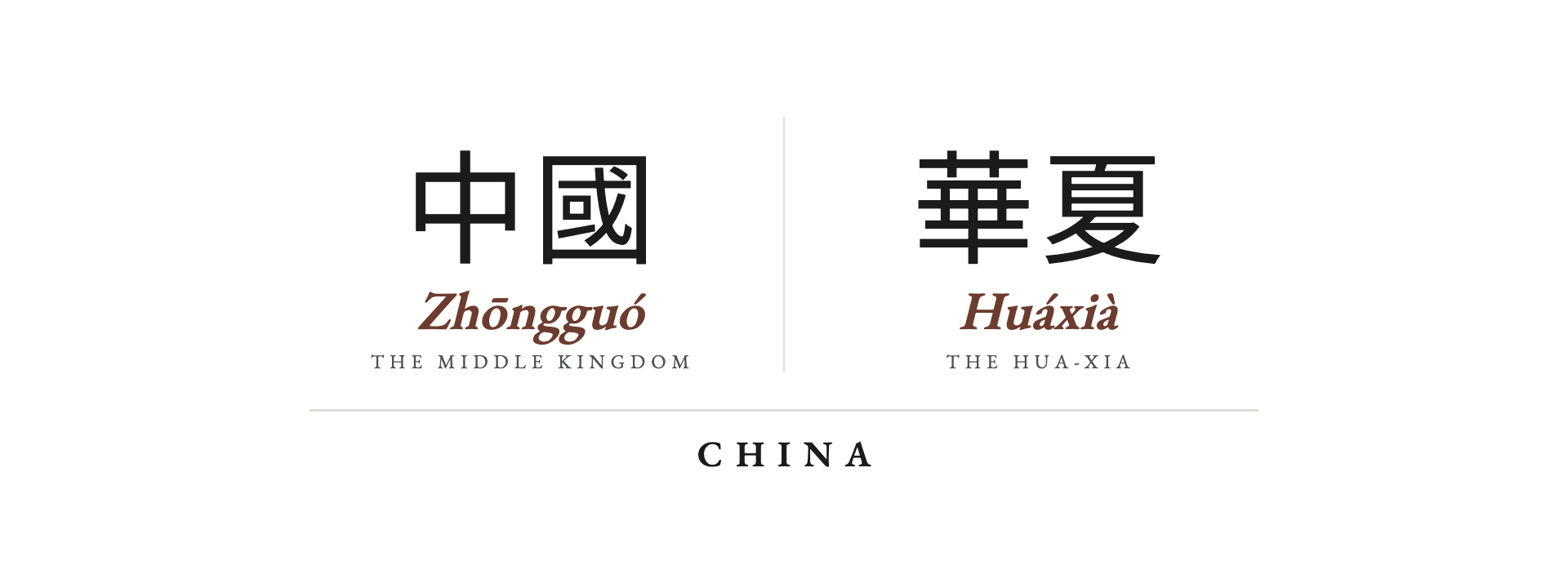
The two exonym families produced one of the most instructive errors in ancient geography. Because silk reached the Mediterranean by two roads, the overland caravan route across Central Asia and the sea route around India, the Greeks and Romans came to believe in two separate countries: Serica, the inland land of the Seres, somewhere beyond the steppe, and the Sinae, a maritime people at the eastern edge of the ocean. Ptolemy maps them as distinct. They were one country approached from two directions, and the recognition that the silk-land of the north and the Sinae of the southern sea were the same place came only slowly. Against these outsiders’ names stand the names China used for itself, which look not outward along a trade road but inward and upward: Zhōngguó, the central state among the states, and Huáxià, the name of the cultural community itself, neither of them a geographer’s coordinate but a claim about the center of the world.
Spot an error or have a suggestion? Send feedback ↓
Name families
Cognate names grouped by shared root. An indented name is borrowed from the form above it; names at the same level are parallel descendants.
The Cīna family
The name of China from the Qín (秦) dynasty, carried out of India as Sanskrit Cīna and through Iran into Persian Čīn, Greek Sînai, Latin Sīnae, Arabic al-Ṣīn, and Syriac Bēth Sīnāyē; the source, through the sea-route form, of the English "China" and the prefix Sino-.
The Sêres family
The Greco-Roman name for the China reached overland, the "silk people" (Greek Sêres, Latin Sēres) and their land Sērikḗ / Sērica, from Greek sḗr, "silk"; the overland twin of the maritime Sînai, and, through Latin sēricum, the hidden source of the word "silk."
Transmission map
Each form at the homeland of its language; arcs follow asserted borrowing paths. Slide to a year to see which names were in use.
in use at this year · formerly in use · not yet attested
✦ China, the heartland
Attestation timeline
When each name is attested, earliest first. Dates bound the name's use, not the language's lifespan.
Names across languages
Classical Chinese c. 1040 BCE – 900 CE #
中國
- Transliteration
- Zhōngguó
- Meaning
- “the central state; the Middle Kingdom”
- Confidence
- attested
The graph-pair 中國 (Zhōngguó) is first attested on the He zun, a Western Zhou ritual bronze of about 1038 BCE, in the phrase zhái zī zhōng guó, “dwell in this central region,” where it denotes the royal domain at the center of the early Zhou world rather than a country. Across the Zhou and into the Han the term widened in stages: from the central capital region, to the cluster of Central Plains states that shared the ritual order of the Hua-Xia, and at last to the whole realm set against the peoples of the four directions. It is built transparently from zhōng (中), “center, middle,” and guó (國), “state, walled domain,” and it is the name modern Chinese still uses for the country.
Zhōngguó is not a geographer’s coordinate but a claim about the center of the world. Where the outside names on this page record the road by which a traveler arrived, naming China for its silk or for the Qín dynasty, the Middle Kingdom is middle cosmologically: the civilized center around which the rest is arranged as periphery. It is the one name here drawn from China’s own political self-conception, and the contrast with Huáxià beside it is exact, the two halves of a self-understanding that the Persia page sets out in the same way with Pārsa and Ērān. The realm names itself by its position at the center; everyone else names it by the direction from which they came.
Sources (2)
- He zun (何尊) bronze vessel inscription, Western Zhou, c. 1038 BCE (Baoji Bronzeware Museum).
- Wilkinson, Endymion. Chinese History: A New Manual. Cambridge, MA: Harvard University Asia Center, 2013, s.v. names of China.
Cite this entry
Rajagopal, Shriram. "Zhōngguó (Classical Chinese name for China)." Onomastikon: A Digital Atlas of Ancient Names. https://onomastikon.org/civilizations/china#classical-chinese-zhongguo.
@misc{onomastikon-china-classical-chinese-zhongguo, author = {Rajagopal, Shriram}, title = {Zhōngguó (Classical Chinese name for China)}, year = {2026}, howpublished = {\url{https://onomastikon.org/civilizations/china#classical-chinese-zhongguo}}, note = {Onomastikon: A Digital Atlas of Ancient Names} }Classical Chinese c. 550 BCE – 600 CE #
華夏
- Transliteration
- Huáxià
- Meaning
- “the Hua and the Xia; the Chinese cultural community”
- Confidence
- attested
Huáxià (華夏) joins huá (華), “florescent, flourishing,” with xià (夏), the name of the legendary first dynasty and of the people of the central plain. It is attested in the Eastern Zhou as the collective self-name of the Central Plains states, opposed to the four surrounding peoples, the Yi, Di, Rong, and Man; the Zuozhuan under Duke Ding pairs the two graphs in parallel cola, “the outer regions do not plot against the Xia, the alien tribes do not bring disorder among the Hua.” The compound and its halves, zhū Xià “the several Xia” and zhū Huá, run through the ritual and historical texts of the Spring and Autumn and Warring States periods as the standing term for the civilized community.
Where Zhōngguó is political and spatial, the state at the center, Huáxià is ethno-cultural, the community itself. The two together reproduce on Chinese ground the same split the Persia page draws between Pārsa, the land and polity, and Ērān, the people and their shared identity: a name for the territory beside a name for the nation that fills it. The line dividing those inside the Hua-Xia from those outside was understood to be one of ritual and dress rather than of birth, a boundary a people could in principle cross by adopting the rites. The Middle Kingdom was a place; the Hua-Xia was a way of life that claimed it.
Sources (2)
- Zuozhuan (Zuo Tradition), Duke Ding 10 (定公十年): "裔不謀夏,夷不亂華."
- Wilkinson, Endymion. Chinese History: A New Manual. Cambridge, MA: Harvard University Asia Center, 2013, s.v. names of China.
Cite this entry
Rajagopal, Shriram. "Huáxià (Classical Chinese name for China)." Onomastikon: A Digital Atlas of Ancient Names. https://onomastikon.org/civilizations/china#classical-chinese-huaxia.
@misc{onomastikon-china-classical-chinese-huaxia, author = {Rajagopal, Shriram}, title = {Huáxià (Classical Chinese name for China)}, year = {2026}, howpublished = {\url{https://onomastikon.org/civilizations/china#classical-chinese-huaxia}}, note = {Onomastikon: A Digital Atlas of Ancient Names} }Biblical Hebrew c. 540 BCE – 500 BCE #
סינים
- Transliteration
- Sînîm
- IPA
- /siːˈniːm/
- Confidence
- disputed
In Isaiah 49:12 the prophet of the exile promises a return of the scattered people from the ends of the earth: “these shall come from far, and these from the north and from the west, and these from the land of Sînîm” (ʾereṣ Sînîm). The identity of Sînîm has been argued since antiquity. One tradition, taken up by some nineteenth-century scholars who heard in it the Cīna/Sina family, read it as a far-eastern land and so as the earliest mention of China in any literature. The reading now preferred by most takes Sînîm as Sĕwēnîm, Syene, the town at Egypt’s southern frontier, the modern Aswan: a reading the Great Isaiah Scroll from Qumran supports outright, since it writes Sĕwēnîm in this verse.
This entry is marked disputed because the disagreement is real and the weaker reading is the more famous one. The structure of the verse argues against China: it sweeps the compass, north and west and then a fourth quarter, and what it wants to close the circuit is a point in the south, which Syene supplies and a land beyond the Himalayas does not. The Qumran variant, the oldest witness to the text, settles the matter for most readers in favor of Syene. Sînîm is included here not as a name of China but as the ghost of one: the haunting, and almost certainly mistaken, possibility that the Hebrew Bible once gestured at the country at the other edge of the world.
Sources (3)
- Isaiah 49:12 (Masoretic Text): "...and these from the land of Sînîm."
- 1QIsaa (Great Isaiah Scroll, Qumran), reading סוניים (Sĕwēnîm, Syene).
- Blenkinsopp, Joseph. Isaiah 40–55. Anchor Bible 19A. New York: Doubleday, 2002, on 49:12.
Cite this entry
Rajagopal, Shriram. "Sînîm (Biblical Hebrew name for China)." Onomastikon: A Digital Atlas of Ancient Names. https://onomastikon.org/civilizations/china#biblical-hebrew-sinim.
@misc{onomastikon-china-biblical-hebrew-sinim, author = {Rajagopal, Shriram}, title = {Sînîm (Biblical Hebrew name for China)}, year = {2026}, howpublished = {\url{https://onomastikon.org/civilizations/china#biblical-hebrew-sinim}}, note = {Onomastikon: A Digital Atlas of Ancient Names} }Sanskrit c. 300 BCE – 600 CE #
चीन
- Transliteration
- Cīna
- IPA
- /ˈt͡ʃiːnɐ/
- Confidence
- attested
Cīna (चीन) is the Sanskrit name for China and the Chinese, attested in the lists of northern and frontier peoples in the Mahābhārata and named in the Manusmṛti among the tribes held to have fallen from their ritual rank. It is most commonly derived from the dynasty and state of Qín (秦), whose name passed south across the trans-Himalayan routes into the Indian world; the derivation is standard, though it has been debated, since the Qín were a recognized power on the northwestern Chinese frontier from early in the first millennium BCE, well before their brief imperial unification of 221 BCE. From Cīna Sanskrit also built Cīnasthāna, “the land of the Cīna,” and the word for the peach, cīnānī, “the Chinese fruit.”
Cīna is the headwater from which the entire western family of China-names flows. Passing from Sanskrit into Iranian and onward through Greek and Latin geography, it becomes Persian Čīn, Greek Sînai, Latin Sīnae, Arabic al-Ṣīn, and at last the English “China.” Every one of those names is, etymologically, the word “Qín,” carried out of India in a Sanskrit mouth. The dynasty that coined it ruled for fifteen years; its name outlived it by more than two thousand and traveled the breadth of the earth, so that half the world now calls the country by the name of a house that fell almost as soon as it rose.
Sources (3)
- Mahābhārata 2.47, 3.48 (the Cīna among the northern peoples bearing tribute).
- Manusmṛti 10.44 (the Cīnas among peoples fallen from rank).
- Monier-Williams, Monier. A Sanskrit-English Dictionary. Oxford: Clarendon Press, 1899, s.v. cīna.
Cite this entry
Rajagopal, Shriram. "Cīna (Sanskrit name for China)." Onomastikon: A Digital Atlas of Ancient Names. https://onomastikon.org/civilizations/china#sanskrit-cina.
@misc{onomastikon-china-sanskrit-cina, author = {Rajagopal, Shriram}, title = {Cīna (Sanskrit name for China)}, year = {2026}, howpublished = {\url{https://onomastikon.org/civilizations/china#sanskrit-cina}}, note = {Onomastikon: A Digital Atlas of Ancient Names} }Ancient Greek c. 50 BCE – 400 CE #
Σῆρες
- Transliteration
- Sêres
- IPA
- /ˈsɛː.res/
- Meaning
- “the silk people”
- Confidence
- attested
Sêres (Σῆρες), “the silk people,” and their land Sērikḗ (Σηρική) are the Greek name for the China reached overland, across the steppe and the mountain passes, at the far end of the caravan road. The name is built on sḗr (σήρ), the silkworm or its thread, the commodity by which alone the Greeks knew the country; Strabo reports the Seres as a remote and famously long-lived people, Ptolemy maps Sērikḗ with its capital Sēra in the northeast of his world, and Pausanias gives a curious account of the sēr and how its fiber is spun. The Greeks did not know the Chinese; they knew their export, and named the makers after it.
Sêres is the overland twin of Sînai, and the pair is the heart of this page. Because silk came west by two routes, the land caravan and the sea lane through India, the Greco-Roman world split one country into two: Sērikḗ in the north, met by land, and the Sînai in the south, met by ship. Ptolemy describes them as separate nations with separate capitals. They were the same place, and the geographers never knew it. The name left its deepest mark not on the map but in the languages of Europe: through Latin sēricum, “silk,” the word for the country dissolved into the word for the cloth, so that Sêres survives, unrecognized, every time the fabric is named.
Sources (3)
- Strabo, Geographica 15.1.34, 11.11.1 (the long-lived Seres of the far east).
- Ptolemy, Geography 6.16 (Sērikḗ and its capital Sēra).
- Pausanias, Description of Greece 6.26.6–9 (the sēr and the making of silk).
Cite this entry
Rajagopal, Shriram. "Sêres (Ancient Greek name for China)." Onomastikon: A Digital Atlas of Ancient Names. https://onomastikon.org/civilizations/china#ancient-greek-seres.
@misc{onomastikon-china-ancient-greek-seres, author = {Rajagopal, Shriram}, title = {Sêres (Ancient Greek name for China)}, year = {2026}, howpublished = {\url{https://onomastikon.org/civilizations/china#ancient-greek-seres}}, note = {Onomastikon: A Digital Atlas of Ancient Names} }Latin c. 30 BCE – 400 CE #
Sēres
- Transliteration
- Sēres
- IPA
- /ˈseː.reːs/
- Meaning
- “the silk people”
- Derived from
- Ancient Greek Sêres
- Confidence
- attested
Latin Sēres, the silk-people, and their country Sērica, are taken from the Greek and carry the same meaning: the overland China known only as the source of silk. The name is already a literary commonplace by the Augustan age. Virgil pictures the Seres combing delicate fleeces from the leaves of their trees, a half-understood account of sericulture; Pliny treats them more soberly as the people at the end of the silk route, beyond the Scythians and the Himalayas. The derived adjective sēricus and the noun sēricum, “silk,” made the country’s name into the ordinary Latin word for the cloth.
Sērica is the half of the China-double that Latin geography kept distinct from the maritime Sīnae down to the end of antiquity, and the misunderstanding outlived Rome. But the name’s true afterlife is lexical. Sēricum passed, through a long chain of borrowings across the late-antique and early-medieval world, into the Germanic word that becomes English “silk,” the liquid most likely substituted for the r somewhere along the Baltic trade. The dynasty of Qín gave its name to “China” by the southern road; by the northern one, the silk-land gave its name to silk. The same country lies hidden in both English words, and in neither is it recognizable.
Sources (3)
- Virgil, Georgics 2.121 (the Seres combing fine fleeces from the leaves).
- Pliny the Elder, Naturalis Historia 6.20, 6.54 (the Seres and the silk trade).
- Lewis, Charlton T., and Charles Short. A Latin Dictionary. Oxford: Clarendon Press, 1879, s.v. Seres, Serica.
Cite this entry
Rajagopal, Shriram. "Sēres (Latin name for China)." Onomastikon: A Digital Atlas of Ancient Names. https://onomastikon.org/civilizations/china#latin-seres.
@misc{onomastikon-china-latin-seres, author = {Rajagopal, Shriram}, title = {Sēres (Latin name for China)}, year = {2026}, howpublished = {\url{https://onomastikon.org/civilizations/china#latin-seres}}, note = {Onomastikon: A Digital Atlas of Ancient Names} }Ancient Greek c. 50 CE – 400 CE #
Σῖναι
- Transliteration
- Sînai
- IPA
- /ˈsiː.nai̯/
- Confidence
- attested
Sînai (Σῖναι), with the byform Thînai (Θῖναι) and the great inland metropolis Thína of the Periplus of the Erythraean Sea, is the Greek name for the people at the southeastern limit of the inhabited world, reached by the sea route around India. The Periplus, a merchant’s handbook of the mid-first century CE, places Thína beyond the Ganges as the source from which raw silk, floss, and cloth came down to the Indian ports; Ptolemy, a century later, maps the Sînai and their capital at the far eastern edge of his world. The name belongs to the same Qín-derived family as Sanskrit Cīna, taken up by Greek through the maritime trade rather than overland.
Sînai is the sea-route name, and that is its significance. The Greeks reached China by two roads and so came to know it as two countries: the Sînai of the southern ocean, met by ship through India, and the Sêres of the northern caravan track, met by land across the steppe. The two are the same place under two names, and a reader of Ptolemy would not have known it. Sînai is the half of that double that the modern world kept; flattened into Latin Sīnae and revived by early-modern geographers, it survives in the learned prefix Sino- and in the very word “China,” while its overland twin faded into a memory of silk.
Sources (2)
- Ptolemy, Geography 7.3 (the Sînai and their metropolis at the eastern edge of the oikoumene).
- Periplus Maris Erythraei 64 (the inland city Thína, source of silk). Casson, Lionel, ed. Princeton: Princeton University Press, 1989.
Cite this entry
Rajagopal, Shriram. "Sînai (Ancient Greek name for China)." Onomastikon: A Digital Atlas of Ancient Names. https://onomastikon.org/civilizations/china#ancient-greek-sinai.
@misc{onomastikon-china-ancient-greek-sinai, author = {Rajagopal, Shriram}, title = {Sînai (Ancient Greek name for China)}, year = {2026}, howpublished = {\url{https://onomastikon.org/civilizations/china#ancient-greek-sinai}}, note = {Onomastikon: A Digital Atlas of Ancient Names} }Latin c. 150 CE – 600 CE #
Sīnae
- Transliteration
- Sīnae
- IPA
- /ˈsiː.nae̯/
- Derived from
- Ancient Greek Sînai
- Confidence
- attested
Sīnae is the Latin name for the southern, sea-reached Chinese, taken over from the Greek Sînai of Ptolemy’s geographical tradition rather than from any Roman contact with China. It enters Latin learning as a coordinate on the inherited map of the world, the easternmost maritime people beyond the mouth of the Ganges, and it keeps in Latin the same partner it had in Greek: the inland Sêres, the silk-people of the caravan road, set apart from the Sīnae of the ocean as if they were two nations.
That inherited confusion is what Sīnae carries into the European tradition. Roman geography never resolved the Serica of the north and the Sīnae of the south into one country; the two names passed down side by side through the medieval manuscripts of Ptolemy and Pliny, and when early-modern scholars recovered them they at first kept the two apart. The eventual triumph of Sīnae over Serica, helped by the matching Arabic al-Ṣīn that the sea-traders brought west, fixed this form as the learned root for China in the modern languages: the Sino- of “Sinology” and “Sino-Tibetan,” and behind a chain of borrowings the everyday word “China” itself. The sea route won the name; the silk road kept only the silk.
Sources (2)
- Smith, William, ed. Dictionary of Greek and Roman Geography. London: Walton and Maberly, 1854, s.v. Sinae.
- Ammianus Marcellinus, Res Gestae 23.6.64 (the Serica and its peoples on the far eastern frontier).
Cite this entry
Rajagopal, Shriram. "Sīnae (Latin name for China)." Onomastikon: A Digital Atlas of Ancient Names. https://onomastikon.org/civilizations/china#latin-sinae.
@misc{onomastikon-china-latin-sinae, author = {Rajagopal, Shriram}, title = {Sīnae (Latin name for China)}, year = {2026}, howpublished = {\url{https://onomastikon.org/civilizations/china#latin-sinae}}, note = {Onomastikon: A Digital Atlas of Ancient Names} }Middle Persian c. 250 CE – 900 CE #
𐫝𐫏𐫗
- Transliteration
- Čīn
- IPA
- /t͡ʃiːn/
- Confidence
- attested
Čīn is the Middle Persian name for China, written here in the Manichaean script (𐫝𐫏𐫗, c-y-n) in which the Manichaean communities of the Iranian east recorded their texts. Manichaeism carried its mission along the Silk Road as far as China itself, and Čīn recurs through the Manichaean corpus recovered at Turfan, the religion naming the very country it had reached. The form belongs to the Qín-derived family, the Iranian reflex of the same name that Sanskrit carries as Cīna. It is given in Manichaean letters rather than the Inscriptional Pahlavi used elsewhere in this atlas for Middle Persian because the Pahlavi script has no sign for the affricate č; the Manichaean alphabet writes it with the letter descended from Aramaic ṣāde, freed for the affricate in a language that had no emphatic ṣ.
Čīn is the Iranian hinge of the whole family. The names that lie west of it, the Greek Sînai and Latin Sīnae, and above all the Arabic al-Ṣīn, took the country through Iran, and the emphatic ṣ of the Arabic form is the fingerprint of this Persian Čīn. The script tells its own version of the same history. To write the name at all, the Iranian Manichaeans needed a letter their inherited Pahlavi could not give them, and they found it by repurposing a Semitic consonant; the name of China survives in Middle Persian only because a borrowed alphabet was bent to hold a sound it was never designed to carry.
Sources (2)
- Durkin-Meisterernst, Desmond. Dictionary of Manichaean Middle Persian and Parthian. Dictionary of Manichaean Texts III/1. Turnhout: Brepols, 2004, s.v. cyn.
- Everson, Michael, Desmond Durkin-Meisterernst, et al. Second revised proposal for encoding the Manichaean script (ISO/IEC JTC1/SC2/WG2 N4029R), 2011 (script and letter values).
Cite this entry
Rajagopal, Shriram. "Čīn (Middle Persian name for China)." Onomastikon: A Digital Atlas of Ancient Names. https://onomastikon.org/civilizations/china#middle-persian-cin.
@misc{onomastikon-china-middle-persian-cin, author = {Rajagopal, Shriram}, title = {Čīn (Middle Persian name for China)}, year = {2026}, howpublished = {\url{https://onomastikon.org/civilizations/china#middle-persian-cin}}, note = {Onomastikon: A Digital Atlas of Ancient Names} }Syriac c. 550 CE – 900 CE #
ܒܝܬ ܣܝܢܝܐ
- Transliteration
- Bēth Sīnāyē
- IPA
- /beːθ siːˈnaːjeː/
- Meaning
- “the land of the Chinese”
- Confidence
- attested
Bēth Sīnāyē (ܒܝܬ ܣܝܢܝܐ), “the land of the Chinese,” is the East Syriac name for China, formed with the toponymic prefix bēth-, “house, land of,” that the Church of the East used across its map of Asia. China was an ecclesiastical province of that church, which sent monks and bishops along the Silk Road as far as the Tang capital; its great monument is the Xi’an stele of 781 CE, a stone inscribed in Chinese and Syriac that records the mission and names its metropolitan see Ṣīnistān. The element Sīnāyē, written with semkath, belongs to the same Cīna/Ṣīn family carried east through Persia.
Bēth Sīnāyē is the only name on this page given by a community that actually reached China and lived in it. Where the Greek and Latin names are coordinates on a geographer’s map and the Sanskrit and Arabic names are the country as known to traders, the Syriac name belongs to a church that built monasteries at Chang’an and translated its scriptures for Chinese readers. The Xi’an stele, carved and then buried for centuries before its rediscovery, is the westernmost of scripts and the easternmost reach of a Syriac-speaking church meeting in a single stone: the alphabet of Edessa, cut in granite, naming the land at the other end of the world.
Sources (2)
- Encyclopedic Dictionary of the Syriac Heritage (GEDSH). Piscataway, NJ: Gorgias Press, 2011, s.v. "China, Syriac Christianity in."
- Xi'an (Nestorian) Stele, 781 CE: the Syriac colophon naming the metropolitan see of Sīnistān (ܣܝܢܣܬܐܢ).
Cite this entry
Rajagopal, Shriram. "Bēth Sīnāyē (Syriac name for China)." Onomastikon: A Digital Atlas of Ancient Names. https://onomastikon.org/civilizations/china#syriac-beth-sinaye.
@misc{onomastikon-china-syriac-beth-sinaye, author = {Rajagopal, Shriram}, title = {Bēth Sīnāyē (Syriac name for China)}, year = {2026}, howpublished = {\url{https://onomastikon.org/civilizations/china#syriac-beth-sinaye}}, note = {Onomastikon: A Digital Atlas of Ancient Names} }Classical Arabic c. 600 CE – 1000 CE #
الصين
- Transliteration
- al-Ṣīn
- IPA
- /asˤˈsˤiːn/
- Derived from
- Middle Persian Čīn
- Confidence
- attested
al-Ṣīn (الصين) is the Arabic name for China, written with the emphatic ṣād. The Arabic geographers and traders made it the standing term for the country at the eastern end of the maritime trade: the Akhbār al-Ṣīn wa-l-Hind, “Accounts of China and India” of 851 CE, is among the earliest detailed Arabic descriptions of the Chinese coast and the port of Canton, and al-Ṣīn recurs throughout the later geographical tradition down to Yāqūt. The form belongs to the Qín-derived family, but it did not come to Arabic directly; the emphatic ṣ, replacing the affricate of Cīna and Čīn, is the trace of its passage through Persian.
That emphatic consonant is the entry’s signature. Arabic received China, like India, along an Iranian road: al-Hind and al-Ṣīn are the twin termini of the Persian-mediated geography the Arabs inherited, and the ṣād of al-Ṣīn marks the same path that the Čīn of Middle Persian lays out one column over. China stood in Arabic for the proverbial edge of the knowable world, the destination of the famous if late-attributed exhortation to seek knowledge “even unto China,” wa-law bi-l-Ṣīn. The country was the far horizon of the earth, and the road to it ran through Iran.
Sources (2)
- Akhbār al-Ṣīn wa-l-Hind (Accounts of China and India), 851 CE. Sauvaget, Jean, ed. Paris: Les Belles Lettres, 1948.
- Yāqūt al-Ḥamawī. Muʿjam al-Buldān. Beirut: Dār Ṣādir, s.v. الصين (al-Ṣīn).
Cite this entry
Rajagopal, Shriram. "al-Ṣīn (Classical Arabic name for China)." Onomastikon: A Digital Atlas of Ancient Names. https://onomastikon.org/civilizations/china#classical-arabic-sin.
@misc{onomastikon-china-classical-arabic-sin, author = {Rajagopal, Shriram}, title = {al-Ṣīn (Classical Arabic name for China)}, year = {2026}, howpublished = {\url{https://onomastikon.org/civilizations/china#classical-arabic-sin}}, note = {Onomastikon: A Digital Atlas of Ancient Names} }Cite this page
Rajagopal, Shriram. "China." Onomastikon: A Digital Atlas of Ancient Names. https://onomastikon.org/civilizations/china.
@misc{onomastikon-china,
  author = {Rajagopal, Shriram},
  title = {China},
  year = {2026},
  howpublished = {\url{https://onomastikon.org/civilizations/china}},
  note = {Onomastikon: A Digital Atlas of Ancient Names}
}Spot an error on this page? Suggest a correction →