Language
Etruscan
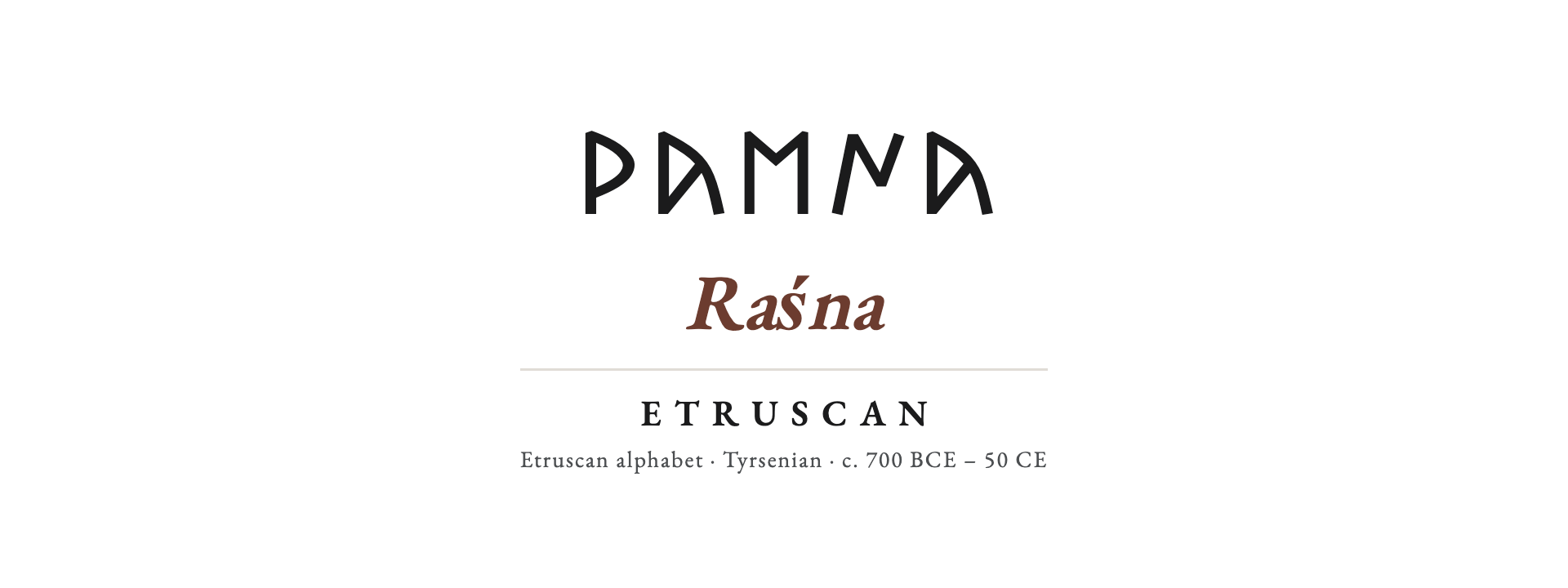
𐌓𐌀𐌑𐌍𐌀
Etruscan was the language of the Etruscans of ancient Italy, the most important non-Indo-European tongue of the pre-Roman peninsula. It is known from some thirteen thousand inscriptions, ranging from about 700 BCE to the first century CE, the great majority of them short funerary and votive texts; the long texts are few, chief among them the linen wrappings of the Zagreb mummy and the Pyrgi gold tablets, an Etruscan-Phoenician bilingual. With the Lemnian of a stele from that Aegean island and the Alpine Raetic it forms the small Tyrsenian family; beyond that it is an isolate, related to no other known language of the ancient world. Its alphabet was borrowed in the seventh century BCE from the Euboean Greeks of Cumae and adapted to Etruscan sounds, and it was normally written right to left.
The script can be read with confidence, since its letters are Greek in origin, but the language itself is only partly understood, its meaning recovered slowly through bilinguals, glosses preserved by Roman authors, and the patient comparison of formulaic texts. The Etruscans called themselves Raśna, and that self-name must stand here for the language as well, for no Etruscan word for “the Etruscan tongue” survives; the texts come nearest with the phrase zich Raśna, “Raśna writing.” Forms are given in the standard transliteration of Rix’s Etruskische Texte, in which ś marks the letter san, distinct from sigma.
Spot an error or have a suggestion? Send feedback ↓
Civilizations named in this language
Cities named in this language
Cite this page
Rajagopal, Shriram. "Etruscan." Onomastikon: A Digital Atlas of Ancient Names. https://onomastikon.org/languages/etruscan.
@misc{onomastikon-etruscan,
  author = {Rajagopal, Shriram},
  title = {Etruscan},
  year = {2026},
  howpublished = {\url{https://onomastikon.org/languages/etruscan}},
  note = {Onomastikon: A Digital Atlas of Ancient Names}
}Spot an error on this page? Suggest a correction →