Language
Lycian
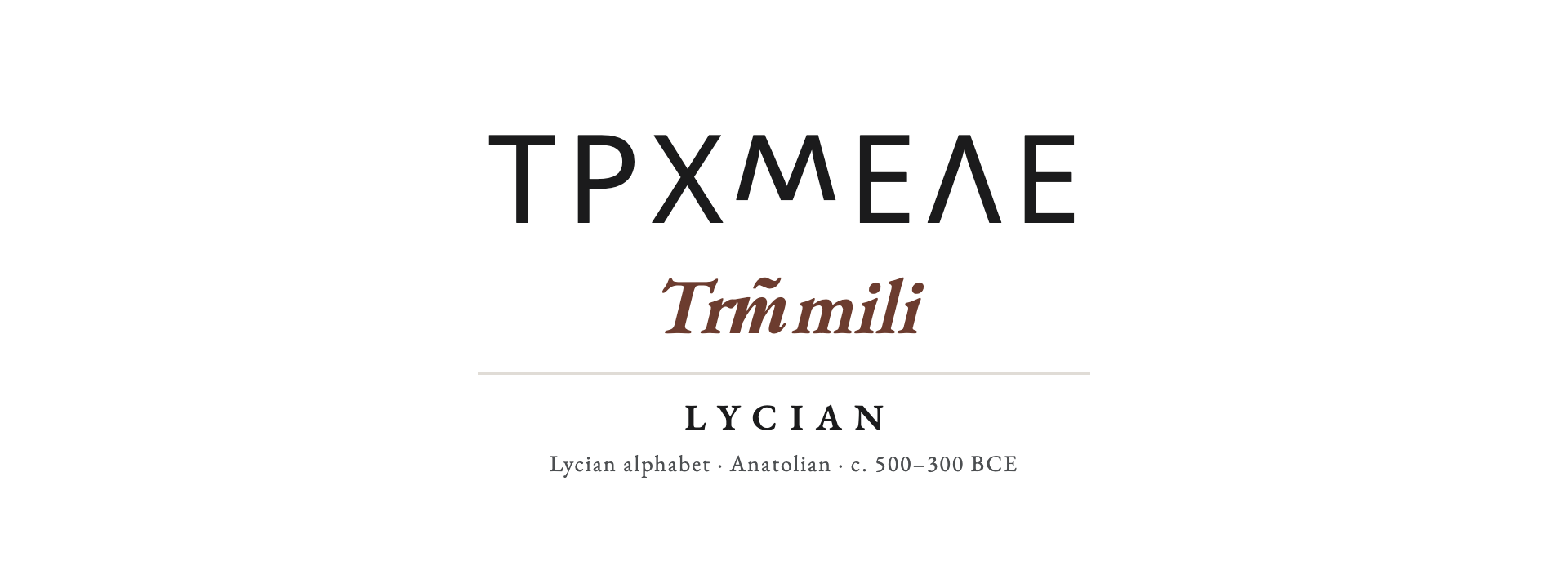
𐊗𐊕𐊐𐊎𐊆𐊍𐊆
The language of ancient Lycia, the mountainous southwestern corner of Anatolia, attested in roughly two hundred inscriptions and a scatter of coin legends of the fifth and fourth centuries BCE. Lycian belongs to the Anatolian branch of Indo-European, the same family as Hittite and Luwian, and descends most closely from Luwian; it is one of the few Anatolian languages to survive into the Classical period and be written in its own alphabet rather than in cuneiform or hieroglyphs. The longest texts are funerary, carved on the rock-cut tombs for which Lycia is known, together with the trilingual Letoon stele in Lycian, Greek, and Aramaic that has been central to the language’s decipherment.
The Lycian alphabet is an epichoric script of about twenty-nine letters, adapted from a Greek alphabet of the archaic period with added signs for sounds Greek lacked, among them the nasalized vowels and the special nasals m̃ and ñ that the script writes with their own characters. The Lycians called themselves Trm̃mili and their land Trm̃mis, names with no resemblance to the Greek Lykía by which the outside world knew them; the language fell out of use after Lycia was absorbed into the Hellenistic world and Greek replaced it.
Spot an error or have a suggestion? Send feedback ↓
Regions named in this language
Cite this page
Rajagopal, Shriram. "Lycian." Onomastikon: A Digital Atlas of Ancient Names. https://onomastikon.org/languages/lycian.
@misc{onomastikon-lycian,
  author = {Rajagopal, Shriram},
  title = {Lycian},
  year = {2026},
  howpublished = {\url{https://onomastikon.org/languages/lycian}},
  note = {Onomastikon: A Digital Atlas of Ancient Names}
}Spot an error on this page? Suggest a correction →