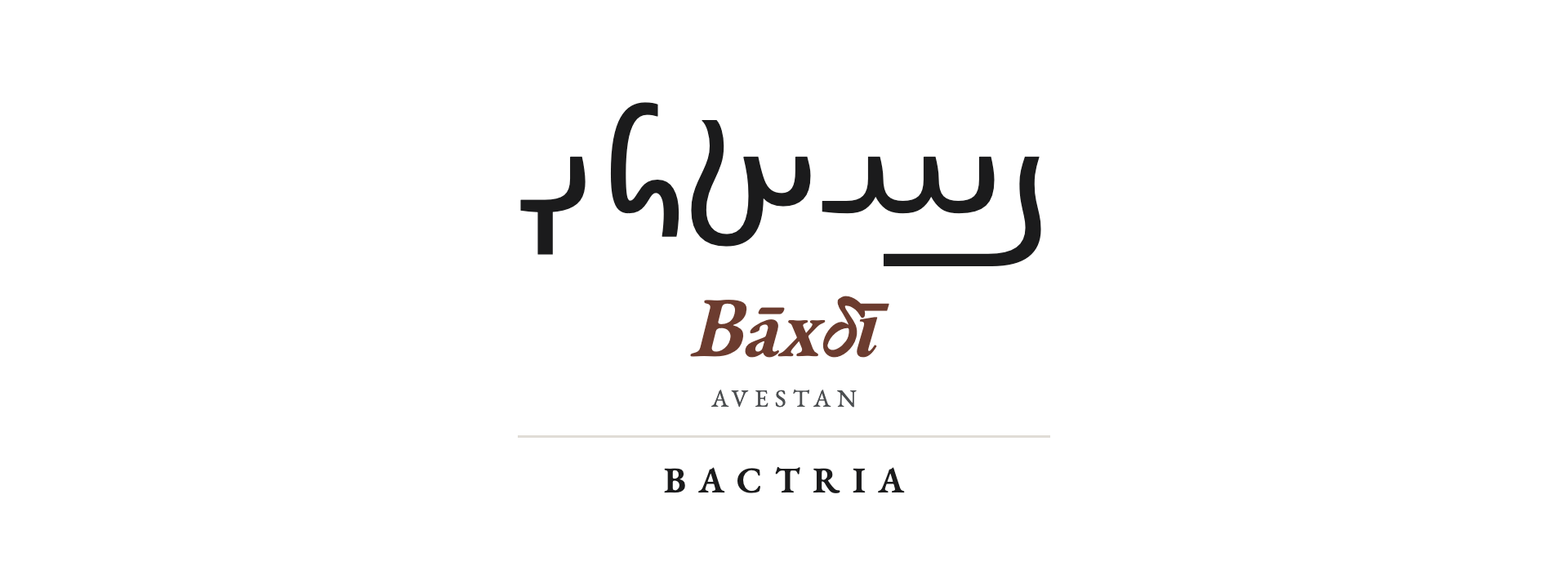
Civilization
Bactria
Also known as: Bāxδī, Baḫtar, Bākšiš, Bāxtriš, Baktrianḗ, Bāhlika, Dàxià, Bactria, Baxl
Bactria was the fertile land of the upper Oxus (Amu Darya), centered on the city of Bactra, modern Balkh, in what is now northern Afghanistan. It was one of the heartlands of the eastern Iranian world: a sacred country in the Zoroastrian tradition, a wealthy satrapy of the Achaemenid empire, and, after Alexander, the seat of the Greco-Bactrian kingdom, where Greek kings struck some of the finest coins of antiquity and Hellenism met the Buddhist world. To the Chinese envoys who reached it in the second century BCE it was the first great civilization of the far west.
The name is one of the oldest in the Iranian world. The Avesta knows the land as Bāxδī, naming it among the sixteen Aryan countries that open the Vendidad, “the beautiful, with uplifted banners”; Old Persian has Bāxtriš in the satrapy lists at Behistun, where it stands in the trilingual Elamite and Akkadian versions as well. From the Iranian name come the Greek Baktría and Latin Bactria that English keeps, and, in the characteristic Iranian xt → hl shape, the Sanskrit Bāhlika by which India knew the Bactrians. In Middle Persian the name softened to Baxl, and that is the form that survives on the ground as Balkh, the city’s name to this day. China alone named the country differently, as Dàxià, by which the Han historians, following Zhang Qian’s embassy, knew the land and its hundred walled towns. This is the first entry in the atlas to carry an Avestan form, the language of the Zoroastrian liturgy that preserves, in its roll of holy lands, some of the earliest names of the eastern Iranian world.
Spot an error or have a suggestion? Send feedback ↓
Name families
Cognate names grouped by shared root. An indented name is borrowed from the form above it; names at the same level are parallel descendants.
The Bāxδī family
The name of Bactria, Avestan Bāxδī (one of the sixteen Aryan lands of the Vendidad) and Old Persian Bāxtriš, carried into Greek Baktría and Latin Bactria and, in the hl-form, the Sanskrit Bāhlika; the Middle Persian Baxl survives as the city Balkh.
Transmission map
Each form at the homeland of its language; arcs follow asserted borrowing paths. Slide to a year to see which names were in use.
in use at this year · formerly in use · not yet attested
✦ Bactria, the heartland
Attestation timeline
When each name is attested, earliest first. Dates bound the name's use, not the language's lifespan.
Names across languages
Avestan c. 1000 BCE – 400 BCE #
𐬠𐬁𐬑𐬜𐬍
- Transliteration
- Bāxδī
- IPA
- /ˈbaːx.ðiː/
- Meaning
- “Bactria (qualified in the Avesta as "the beautiful, with uplifted banners")”
- Confidence
- attested
The Avestan name of the land, Bāxδī, listed in the first chapter of the Vendidad among the sixteen good lands that Ahura Mazda created, where it is called “the beautiful, with uplifted banners,” a phrase taken to evoke a prosperous country of forts and standards. It is the easternmost-rooted form of the name and the oldest, belonging to the sacred geography of Zoroastrianism, in which Bactria figures as one of the holy Aryan countries. The Avestan-script form follows the standard transliteration letter for letter, the script itself being a later Sasanian invention for the orally transmitted liturgy.
Bāxδī is the first Avestan form in this atlas, and it announces what the language is here for: the Vendidad’s roll of the sixteen lands preserves the names of the eastern Iranian world, Sogdiana, Margiana, the Helmand, the Seven Rivers, at a depth no other source reaches. Bactria’s name in that list, with its δ where Old Persian has xt, shows the eastern Iranian shape of the word beside the southwestern Achaemenid one, the same land named by two branches of Iranian as it would later be by Greek, Indian, and Chinese.
Sources (2)
- Vendidad (Vidēvdāt) 1.6 (the list of the sixteen lands created by Ahura Mazda).
- Gnoli, Gherardo. Encyclopaedia Iranica, s.v. "Bactria ii. In the Avesta and in Zoroastrian Tradition".
Cite this entry
Rajagopal, Shriram. "Bāxδī (Avestan name for Bactria)." Onomastikon: A Digital Atlas of Ancient Names. https://onomastikon.org/civilizations/bactria#avestan-baxdi.
@misc{onomastikon-bactria-avestan-baxdi, author = {Rajagopal, Shriram}, title = {Bāxδī (Avestan name for Bactria)}, year = {2026}, howpublished = {\url{https://onomastikon.org/civilizations/bactria#avestan-baxdi}}, note = {Onomastikon: A Digital Atlas of Ancient Names} }Akkadian c. 520 BCE – 330 BCE #
𒁀𒄴𒋻
- Transliteration
- Baḫtar
- IPA
- /baxˈtar/
- Meaning
- “Bactria”
- Confidence
- attested
The Akkadian name of the province, Baḫtar, the form Bactria takes in the Babylonian version of the Behistun inscription, written in the classical Mesopotamian cuneiform that the Achaemenid chancellery kept as the third of its languages. The Babylonian scribes rendered Old Persian Bāxtriš as ba-aḫ-tar, dropping the difficult final cluster and giving the name a plain Akkadian shape.
Baḫtar completes the trilingual at Behistun, the third witness beside Old Persian Bāxtriš and Elamite Bākšiš. The three forms are not borrowings one from another but parallel official renderings of the same satrapy name, each cut in its own script for its own reading public; together they show a single Persian word refracted through the three great writing traditions the empire inherited. It is the same imperial machinery that names Egypt and the Ionians thrice over: to be a province of Darius was, among other things, to have one’s name set down in three tongues at once.
Sources (2)
- Kent, Roland G. Old Persian: Grammar, Texts, Lexicon. 2nd ed. New Haven: American Oriental Society, 1950, s.v. Bāxtri- (Akk. ba-aḫ-tar).
- von Voigtländer, Elizabeth N. The Bisitun Inscription of Darius the Great: Babylonian Version. London: Lund Humphries, 1978; Weissbach, F. H. Die Keilinschriften der Achämeniden. Leipzig, 1911.
Cite this entry
Rajagopal, Shriram. "Baḫtar (Akkadian name for Bactria)." Onomastikon: A Digital Atlas of Ancient Names. https://onomastikon.org/civilizations/bactria#akkadian-bahtar.
@misc{onomastikon-bactria-akkadian-bahtar, author = {Rajagopal, Shriram}, title = {Baḫtar (Akkadian name for Bactria)}, year = {2026}, howpublished = {\url{https://onomastikon.org/civilizations/bactria#akkadian-bahtar}}, note = {Onomastikon: A Digital Atlas of Ancient Names} }Elamite c. 520 BCE – 330 BCE #
𒁀𒀝𒅆𒅖
- Transliteration
- Bākšiš
- IPA
- *bakʃiʃ
- Meaning
- “Bactria”
- Derived from
- Old Persian Bāxtriš
- Confidence
- attested
The Elamite name of the province, Bākšiš, the form in which Bactria appears in the Elamite version of Darius the Great’s great trilingual inscription at Behistun, among the lands the king lists as his. Elamite, lacking the consonant cluster of Old Persian Bāxtriš, rendered the name with its own syllabary as ba-ak-ši-iš, smoothing the -xtr- to -kš-; a second, more learned Elamite spelling, ba-ik-tur-ri-iš, keeps closer to the Persian.
Bākšiš is one of the three chancellery faces of a single imperial name. The Achaemenids governed in three written languages, and at Behistun, Naqsh-e Rustam, and Persepolis the same satrapy is named in Old Persian, Elamite, and Babylonian Akkadian together; Bactria’s Bāxtriš, Bākšiš, and Baḫtar are that trilingual set. The Elamite form is the one most reshaped by the receiving language, the Persian name caught in the act of being respelled by the scribes of an older Iranian bureaucracy that had no sound for its middle.
Sources (2)
- Kent, Roland G. Old Persian: Grammar, Texts, Lexicon. 2nd ed. New Haven: American Oriental Society, 1950, s.v. Bāxtri- (Elam. ba-ak-ši-iš).
- Behistun inscription (DB), Elamite version, §6; cf. the CDLI edition of the Elamite Behistun text.
Cite this entry
Rajagopal, Shriram. "Bākšiš (Elamite name for Bactria)." Onomastikon: A Digital Atlas of Ancient Names. https://onomastikon.org/civilizations/bactria#elamite-baksis.
@misc{onomastikon-bactria-elamite-baksis, author = {Rajagopal, Shriram}, title = {Bākšiš (Elamite name for Bactria)}, year = {2026}, howpublished = {\url{https://onomastikon.org/civilizations/bactria#elamite-baksis}}, note = {Onomastikon: A Digital Atlas of Ancient Names} }Old Persian c. 520 BCE – 330 BCE #
𐎲𐎠𐎧𐎫𐎼𐎡𐏁
- Transliteration
- Bāxtriš
- IPA
- /ˈbaːx.tri.ʃ/
- Meaning
- “Bactria (the Achaemenid satrapy)”
- Confidence
- attested
The Old Persian name of the satrapy, Bāxtriš, in the roll of lands at Behistun, where Bactria sits among the easternmost provinces of Darius’s empire beside Aria, Chorasmia, Sogdiana, and Gandara. The Achaemenids prized it as a wealthy and strategic frontier, governed often by a royal prince, and it appears in the trilingual inscription in the Elamite and Akkadian versions as well as the Old Persian, in the customary three chancellery languages.
Bāxtriš is the southwestern Iranian form beside the Avestan Bāxδī, the two differing where eastern Iranian δ answers to the xt of the Persian court language. It is also the form the Greeks heard and made into Baktría: standing in the same Behistun satrapy list as Parθava, it took the same road westward, through Greek and Latin, to become the Bactria of the modern map, while the eastern Bāxδī stayed in the liturgy and the hl-form went east to India.
Sources (2)
- Kent, Roland G. Old Persian: Grammar, Texts, Lexicon. 2nd ed. New Haven: American Oriental Society, 1953, s.v. Bāxtri-.
- Behistun inscription (DB), Old Persian version (the satrapy list, column I).
Cite this entry
Rajagopal, Shriram. "Bāxtriš (Old Persian name for Bactria)." Onomastikon: A Digital Atlas of Ancient Names. https://onomastikon.org/civilizations/bactria#old-persian-baxtrish.
@misc{onomastikon-bactria-old-persian-baxtrish, author = {Rajagopal, Shriram}, title = {Bāxtriš (Old Persian name for Bactria)}, year = {2026}, howpublished = {\url{https://onomastikon.org/civilizations/bactria#old-persian-baxtrish}}, note = {Onomastikon: A Digital Atlas of Ancient Names} }Ancient Greek c. 330 BCE – 300 CE #
Βακτριανή
- Transliteration
- Baktrianḗ
- IPA
- /bak.tri.a.ˈnɛː/
- Meaning
- “Bactria (the land; the city was Báktra)”
- Derived from
- Old Persian Bāxtriš
- Confidence
- attested
The Greek name of the land, Baktrianḗ (the region) beside Báktra (its chief city), taken from the Iranian Bāxtriš. Bactria entered Greek horizons with Alexander, who took it with difficulty, and it became the seat of the Greco-Bactrian kingdom, a Hellenistic state so remote that Greek authors called it the land “of the thousand cities”; its kings, known largely from their superb coinage, carried Greek rule to the edge of India.
Baktrianḗ is the form through which the West received the name, ancestor of the Latin Bactria and the English. It preserves the Iranian xt that the Persian court form had, frozen in Greek at the moment of borrowing, just as Parthía froze the rth of Parθava. The Greeks who ruled Bactria for a century and more left their version of its name to the modern world, even as the land itself passed back to Iranian and then Turkic and Mongol hands and kept, on the ground, the quite different name Balkh.
Sources (2)
- Strabo, Geography 11.11; Polybius, Histories 10.49, 11.34.
- Liddell, Henry George, and Robert Scott. A Greek-English Lexicon (LSJ). 9th ed. Oxford: Clarendon Press, 1940, s.v. Βάκτρα, Βακτριανή.
Cite this entry
Rajagopal, Shriram. "Baktrianḗ (Ancient Greek name for Bactria)." Onomastikon: A Digital Atlas of Ancient Names. https://onomastikon.org/civilizations/bactria#ancient-greek-baktria.
@misc{onomastikon-bactria-ancient-greek-baktria, author = {Rajagopal, Shriram}, title = {Baktrianḗ (Ancient Greek name for Bactria)}, year = {2026}, howpublished = {\url{https://onomastikon.org/civilizations/bactria#ancient-greek-baktria}}, note = {Onomastikon: A Digital Atlas of Ancient Names} }Sanskrit c. 150 BCE – 600 CE #
बाह्लिक
- Transliteration
- Bāhlika
- IPA
- /ˈbaːɦlikɐ/
- Meaning
- “Bactria; the Bactrians (the Bāhlikas of Indian texts)”
- Confidence
- attested
The Sanskrit name for Bactria and its people, Bāhlika, used in the epics, the Puranas, and the geographical and medical literature for the land beyond the northwestern passes, famous in India for its horses and its asafoetida. The form reflects the Iranian Bāxl with the xl/hl shape rather than the Old Persian xt, marking it, like the Sanskrit Pahlava for Parthia, as a borrowing of the softened eastern Iranian pronunciation.
Bāhlika is the Indian face of the name, and its hl is a quiet piece of evidence. Where Greek and Latin froze the older Bāxt-, India took the name in the later Bāxl- form that also gives Middle Persian Baxl and the modern Balkh; the same sound-change that turns Parthian Parθaw into Pahlaw stands behind the difference between Bactria and Bāhlika. India and the West thus name one land at two stages of a single Iranian word, the West early and India late.
Sources (2)
- Monier-Williams, Monier. A Sanskrit-English Dictionary. Oxford: Clarendon Press, 1899, s.v. bāhlika.
- Sanskrit epic and Puranic usage (the Bāhlikas among the northwestern peoples).
Cite this entry
Rajagopal, Shriram. "Bāhlika (Sanskrit name for Bactria)." Onomastikon: A Digital Atlas of Ancient Names. https://onomastikon.org/civilizations/bactria#sanskrit-bahlika.
@misc{onomastikon-bactria-sanskrit-bahlika, author = {Rajagopal, Shriram}, title = {Bāhlika (Sanskrit name for Bactria)}, year = {2026}, howpublished = {\url{https://onomastikon.org/civilizations/bactria#sanskrit-bahlika}}, note = {Onomastikon: A Digital Atlas of Ancient Names} }Classical Chinese c. 130 BCE – 100 CE #
大夏
- Transliteration
- Dàxià
- Meaning
- “Bactria (as known to the Han; the relation to the native name is debated)”
- Confidence
- disputed
The Classical Chinese name for Bactria, Dàxià, recorded in the Shiji from the report of the Han envoy Zhang Qian, who reached the region around 129 BCE and described a settled country of walled towns and markets, lately overrun by nomads. Whether Dàxià is a transcription of a native name (perhaps of the Tukhāra, the people who gave Bactria its later name Tokharistan) or an older Chinese geographical term reapplied to the western land is debated, which is why it is marked disputed here.
Dàxià is the page’s outlier, the one name not clearly descended from the Iranian Bāxtriš/Bāxδī. It belongs to the same entity by reference rather than by sound: like the Chinese Ānxī for Parthia, it is a name given from the far side of Asia by observers to whom the land’s own name may have come secondhand, through the nomads of the steppe. To the Han historians, the first great civilization of the west was simply Dàxià, and through Zhang Qian’s account it entered Chinese geography as the gateway to the lands beyond the Pamirs.
Sources (2)
- Sima Qian, Shiji 123 (Dayuan liezhuan, the report of Zhang Qian).
- Pulleyblank, Edwin G. Encyclopaedia Iranica, s.v. "Chinese-Iranian Relations".
Cite this entry
Rajagopal, Shriram. "Dàxià (Classical Chinese name for Bactria)." Onomastikon: A Digital Atlas of Ancient Names. https://onomastikon.org/civilizations/bactria#classical-chinese-daxia.
@misc{onomastikon-bactria-classical-chinese-daxia, author = {Rajagopal, Shriram}, title = {Dàxià (Classical Chinese name for Bactria)}, year = {2026}, howpublished = {\url{https://onomastikon.org/civilizations/bactria#classical-chinese-daxia}}, note = {Onomastikon: A Digital Atlas of Ancient Names} }Latin c. 50 BCE – 500 CE #
Bactria
- Transliteration
- Bactria
- IPA
- /ˈbak.tri.a/
- Meaning
- “Bactria (also Bactriana)”
- Derived from
- Ancient Greek Baktrianḗ
- Confidence
- attested
The Latin name of the land, Bactria (also Bactriana), taken from the Greek. Rome knew Bactria mainly through the histories of Alexander and as a byword for the remote and fabulous East; Curtius Rufus describes its rugged wealth, and Pliny places it on the Oxus at the edge of the known world. The form passed through Latin into the European languages as the standard name of the region.
Bactria is the western terminus of the Iranian name, the form modern atlases use. It completes a familiar pattern: the Iranian Bāxtriš, taken into Greek and then Latin, reaches the modern West with its ancient ct intact, while the same name in the East had long since become Bāhlika in India and Balkh in Persian. The land of a hundred cities is known to the West by the Greeks’ and Romans’ word for it, and to its own country by a name they would scarcely recognize.
Sources (2)
- Pliny the Elder, Naturalis Historia 6.47–48; Quintus Curtius Rufus, Historiae Alexandri 7.4.
- Lewis, Charlton T., and Charles Short. A Latin Dictionary. Oxford: Clarendon Press, 1879, s.v. Bactria, Bactra.
Cite this entry
Rajagopal, Shriram. "Bactria (Latin name for Bactria)." Onomastikon: A Digital Atlas of Ancient Names. https://onomastikon.org/civilizations/bactria#latin-bactria.
@misc{onomastikon-bactria-latin-bactria, author = {Rajagopal, Shriram}, title = {Bactria (Latin name for Bactria)}, year = {2026}, howpublished = {\url{https://onomastikon.org/civilizations/bactria#latin-bactria}}, note = {Onomastikon: A Digital Atlas of Ancient Names} }Middle Persian c. 224 CE – 900 CE #
𐭡𐭠𐭧𐭫
- Transliteration
- Baxl
- IPA
- /baxl/
- Meaning
- “Bactria; Balkh”
- Confidence
- attested
The Middle Persian name of the land, Baxl, the Sasanian-era form of the old Iranian name, written in the Pahlavi script. By the regular change that turned Old Iranian -xt- and -θr- into -hl- and -xl- in the later language, Bāxtriš became Baxl, the same softening that turned Parthian Parθaw into Pahlaw; the Bactrian inhabitants’ own late form, βαχλο, shows the identical outcome.
Baxl is the living end of the name, the form that did not stay on a monument but went on being spoken. From it comes the Arabic Balḫ and the modern Balkh, the city’s name in Afghanistan to this day, so that the Achaemenid Bāxtriš of the Behistun rock and the dusty northern town are the same word a thousand years apart. Of all the names of Bactria, this is the one that the ground still answers to.
Sources (2)
- MacKenzie, D. N. A Concise Pahlavi Dictionary. London: Oxford University Press, 1971.
- Gnoli, Gherardo. "Bactria." In Encyclopaedia Iranica; cf. Šahrestānīhā ī Ērānšahr.
Cite this entry
Rajagopal, Shriram. "Baxl (Middle Persian name for Bactria)." Onomastikon: A Digital Atlas of Ancient Names. https://onomastikon.org/civilizations/bactria#middle-persian-baxl.
@misc{onomastikon-bactria-middle-persian-baxl, author = {Rajagopal, Shriram}, title = {Baxl (Middle Persian name for Bactria)}, year = {2026}, howpublished = {\url{https://onomastikon.org/civilizations/bactria#middle-persian-baxl}}, note = {Onomastikon: A Digital Atlas of Ancient Names} }Cite this page
Rajagopal, Shriram. "Bactria." Onomastikon: A Digital Atlas of Ancient Names. https://onomastikon.org/civilizations/bactria.
@misc{onomastikon-bactria,
  author = {Rajagopal, Shriram},
  title = {Bactria},
  year = {2026},
  howpublished = {\url{https://onomastikon.org/civilizations/bactria}},
  note = {Onomastikon: A Digital Atlas of Ancient Names}
}Spot an error on this page? Suggest a correction →