Civilization
The Cimmerians
Also known as: Gimirru, Kimmérioi, Gomer, Cimmerii
The Cimmerians were the first of the great steppe peoples to crash into the settled Near East. Pushed out of the Pontic grasslands by the advancing Scythians, as Herodotus tells it, they poured through the Caucasus into Anatolia in the late eighth and seventh centuries BCE, destroyed the kingdom of Phrygia and its king Midas, harried Lydia and Urartu, and fought the Assyrians, whose annals record the Gimirru as a deadly new enemy from the north. Within a century they had spent themselves and vanished, the opening act of a pattern the Scythians, Xiongnu, and Huns would each repeat.
The Cimmerians carry a single name across the languages that met them: the Assyrian Gimirru, the Hebrew Gomer, the Greek Kimmérioi, and the Latin Cimmerii. The Hebrew form sets up a striking coincidence of genealogy and history. In the table of nations Gomer is the firstborn of Japheth and the father of Aškenaz; that is, the Cimmerians are made the father of the Scythians. The fiction tracks the fact exactly, for the Cimmerians came first and the Scythians drove them out and inherited the steppe, so that the order of the generations in Genesis preserves, by accident or memory, the real sequence of the peoples.
Spot an error or have a suggestion? Send feedback ↓
Name families
Cognate names grouped by shared root. An indented name is borrowed from the form above it; names at the same level are parallel descendants.
The Gomer family
The name of the Cimmerians, from a single *Gimir-: the Assyrian Gimirru and Hebrew Gomer, the Greek Kimmérioi and Latin Cimmerii; the steppe raiders who broke into Anatolia in the early first millennium.
Transmission map
Each form at the homeland of its language; arcs follow asserted borrowing paths. Slide to a year to see which names were in use.
in use at this year · formerly in use · not yet attested
✦ Cimmeria, the heartland
Attestation timeline
When each name is attested, earliest first. Dates bound the name's use, not the language's lifespan.
Names across languages
Akkadian c. 720 BCE – 640 BCE #
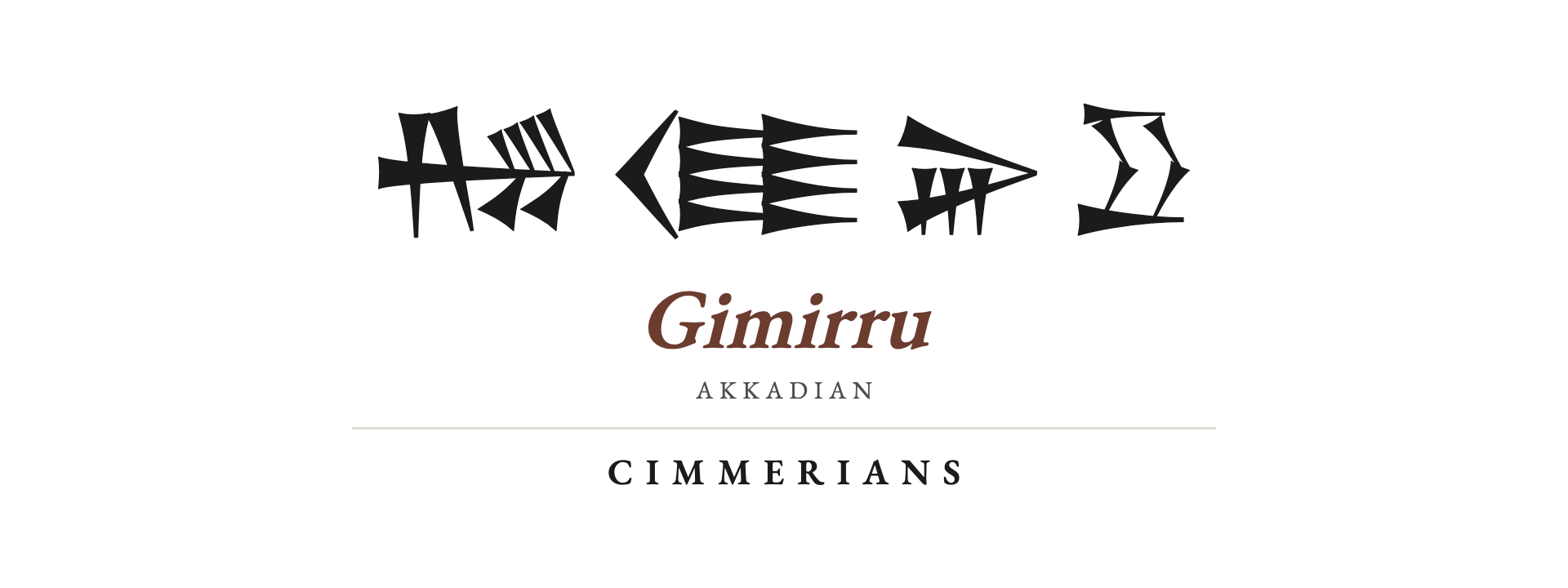
𒄀𒈪𒅕𒊒
- Transliteration
- Gimirru
- IPA
- /ɡiˈmir.ru/
- Confidence
- attested
The Assyrian name of the Cimmerians, Gimirru (gentilic Gimirrāya), the first of the steppe peoples to appear in the cuneiform record. From the reign of Sargon II, who may have died fighting them, the Assyrian texts track the Gimirru as a deadly new force out of the north: they shattered Urartu, overran Phrygia, and pressed on Lydia, whose king Gyges appealed to Ashurbanipal for help against them. The Assyrians faced them as raiders no settled army could easily hold.
Gimirru is the form that anchors the Cimmerians in datable history, the people of Homer’s fog given a hard chronology in the royal annals. It is also the source of the Hebrew Gomer, and through the parallel between Gimirru and the Scythian Iškuza in the Assyrian record runs the same relationship the Hebrew table of nations preserves as father and son. The two peoples the Assyrians knew as Gimirru and Iškuza, the Cimmerians and the Scythians, the Bible would remember as Gomer and Aškenaz, the older nomad and the younger that displaced him.
Sources (2)
- Royal inscriptions and oracle queries of Sargon II, Esarhaddon, and Ashurbanipal (the Gimirrāya in Urartu, Tabal, and Lydia).
- Ivantchik, Askold. Les Cimmériens au Proche-Orient. Fribourg: Universitätsverlag, 1993.
Cite this entry
Rajagopal, Shriram. "Gimirru (Akkadian name for The Cimmerians)." Onomastikon: A Digital Atlas of Ancient Names. https://onomastikon.org/civilizations/cimmerians#akkadian-gimirru.
@misc{onomastikon-cimmerians-akkadian-gimirru, author = {Rajagopal, Shriram}, title = {Gimirru (Akkadian name for The Cimmerians)}, year = {2026}, howpublished = {\url{https://onomastikon.org/civilizations/cimmerians#akkadian-gimirru}}, note = {Onomastikon: A Digital Atlas of Ancient Names} }Ancient Greek c. 700 BCE – 300 CE #
Κιμμέριοι
- Transliteration
- Kimmérioi
- IPA
- /kim.ˈme.ri.oi̯/
- Confidence
- attested
The Greek name of the Cimmerians, Kimmérioi. They enter Greek literature twice over: as the misty people at the edge of the world in the Odyssey, dwelling in perpetual fog beyond the Ocean where Odysseus goes down to the dead, and as a real historical scourge in Herodotus, who reports that the Cimmerians, driven from the Pontic steppe by the Scythians, swept through Anatolia, where they sacked cities and killed the Lydian king’s forebears.
Kimmérioi is the Greek member of the *Gomer family, the same name the Assyrians wrote Gimirru and the Hebrews Gomer. The doubling of the Cimmerians in Greek, half mythical shadow-people, half remembered invaders, is characteristic of how the Greeks held their oldest barbarian neighbors, at once a name out of Homeric legend and a force their grandfathers had fought. The historical Cimmerians vanished within a century; the Homeric Kimmérioi at the gates of the underworld outlived them by the whole length of the classical tradition.
Sources (2)
- Homer, Odyssey 11.13–19 (the Kimmérioi at the edge of the world); Herodotus, Historiae 1.6, 1.15, 4.11–12.
- Liddell, Henry George, and Robert Scott. A Greek-English Lexicon (LSJ). 9th ed. Oxford: Clarendon Press, 1940, s.v. Κιμμέριοι.
Cite this entry
Rajagopal, Shriram. "Kimmérioi (Ancient Greek name for The Cimmerians)." Onomastikon: A Digital Atlas of Ancient Names. https://onomastikon.org/civilizations/cimmerians#ancient-greek-kimmerioi.
@misc{onomastikon-cimmerians-ancient-greek-kimmerioi, author = {Rajagopal, Shriram}, title = {Kimmérioi (Ancient Greek name for The Cimmerians)}, year = {2026}, howpublished = {\url{https://onomastikon.org/civilizations/cimmerians#ancient-greek-kimmerioi}}, note = {Onomastikon: A Digital Atlas of Ancient Names} }Biblical Hebrew c. 700 BCE – 200 BCE #
גֹּמֶר
- Transliteration
- Gomer
- IPA
- /ˈɡoː.mɛr/
- Confidence
- attested
The Hebrew name Gomer, in the table of nations the firstborn son of Japheth and the father of Aškenaz, Riphath, and Togarmah; in Ezekiel, one of the far-northern peoples mustered in the army of Gog. It is identified with the Assyrian Gimirru, the Cimmerians, the same northern raiders the cuneiform sources knew, placed by the Hebrew geographers among the remote peoples of the north.
Gomer completes the *Gomer family, the Cimmerian name in Hebrew beside the Assyrian Gimirru, Greek Kimmérioi, and Latin Cimmerii. Its genealogical position is the quietly remarkable thing: by making Gomer the father of Aškenaz, the table of nations encodes the historical truth that the Cimmerians preceded the Scythians on the steppe and were driven out by them. Whether this is memory or coincidence, the Hebrew text preserves the right order of the peoples, the Cimmerian Gomer begetting the Scythian Aškenaz exactly as the one nomad nation gave way to the other on the grasslands north of the Caucasus.
Sources (2)
- Genesis 10:2–3; 1 Chronicles 1:5–6; Ezekiel 38:6.
- Köhler, Ludwig, and Walter Baumgartner. Hebrew and Aramaic Lexicon of the Old Testament (HALOT). Leiden: Brill, 1994–2000, s.v. גֹּמֶר.
Cite this entry
Rajagopal, Shriram. "Gomer (Biblical Hebrew name for The Cimmerians)." Onomastikon: A Digital Atlas of Ancient Names. https://onomastikon.org/civilizations/cimmerians#biblical-hebrew-gomer.
@misc{onomastikon-cimmerians-biblical-hebrew-gomer, author = {Rajagopal, Shriram}, title = {Gomer (Biblical Hebrew name for The Cimmerians)}, year = {2026}, howpublished = {\url{https://onomastikon.org/civilizations/cimmerians#biblical-hebrew-gomer}}, note = {Onomastikon: A Digital Atlas of Ancient Names} }Latin c. 50 BCE – 400 CE #
Cimmerii
- Transliteration
- Cimmerii
- IPA
- /kimˈme.ri.iː/
- Derived from
- Ancient Greek Kimmérioi
- Confidence
- attested
The Latin name of the Cimmerians, Cimmerii, taken from the Greek; the Romans inherited the Greek doubling of the people into a historical nation and a land of perpetual darkness. Ovid sets the cave of Sleep in a sunless Cimmerian land where the god of dreams lies in eternal night, and the phrase “Cimmerian darkness,” Cimmeriae tenebrae, became a Latin commonplace for total gloom, the Homeric fog hardened into a proverb.
Cimmerii carries the *Gomer family into the European languages, where “Cimmerian” survives chiefly in that proverbial darkness and as the scholarly name for the historical people. By the Roman period the actual Cimmerians were a thousand years gone, the first of the steppe nations to come and go; what remained was the literary shadow, the misty people at the world’s edge. The Latin thus fixed two legacies of one name, the historical Cimmerians of the Assyrian wars and the imaginary Cimmerians of the land of night, both descended from the raiders the Hebrews called Gomer.
Sources (2)
- Cicero, Academica 2.61; Pliny the Elder, Naturalis Historia 6.39; Ovid, Metamorphoses 11.592–594 (the Cimmerian land of sleep).
- Lewis, Charlton T., and Charles Short. A Latin Dictionary. Oxford: Clarendon Press, 1879, s.v. Cimmerii.
Cite this entry
Rajagopal, Shriram. "Cimmerii (Latin name for The Cimmerians)." Onomastikon: A Digital Atlas of Ancient Names. https://onomastikon.org/civilizations/cimmerians#latin-cimmerii.
@misc{onomastikon-cimmerians-latin-cimmerii, author = {Rajagopal, Shriram}, title = {Cimmerii (Latin name for The Cimmerians)}, year = {2026}, howpublished = {\url{https://onomastikon.org/civilizations/cimmerians#latin-cimmerii}}, note = {Onomastikon: A Digital Atlas of Ancient Names} }Cite this page
Rajagopal, Shriram. "The Cimmerians." Onomastikon: A Digital Atlas of Ancient Names. https://onomastikon.org/civilizations/cimmerians.
@misc{onomastikon-cimmerians,
  author = {Rajagopal, Shriram},
  title = {The Cimmerians},
  year = {2026},
  howpublished = {\url{https://onomastikon.org/civilizations/cimmerians}},
  note = {Onomastikon: A Digital Atlas of Ancient Names}
}Spot an error on this page? Suggest a correction →