Civilization
Elam
Also known as: Elam, Haltamti, Elamtu, ʿÊlām, Ūvja, ʿylm, Elymaís, Elymais, ʿĒlām, Hūzestān, Elam, al-Ahwāz
Elam was the civilization of the southwestern Iranian lowlands and the Zagros highlands behind them, centered on its twin capitals of Susa on the plain and Anshan in the mountains. One of the oldest literate cultures of the Near East, it ran from the Proto-Elamite period of the late fourth millennium through the Old, Middle, and Neo-Elamite kingdoms, a near-constant presence on Mesopotamia’s eastern flank: sacking Ur, ruling Babylon, carrying off the stela of Naram-Sin and the law-stele of Hammurabi as war-trophies to Susa, and warring with Assyria until Ashurbanipal sacked Susa around 646 BCE. When Cyrus the Great rose, it was from Anshan, and Elam passed into the Persian Empire as the satrapy that gave the Achaemenids their administrative language and their winter capital. The Elamite language is a linguistic isolate, related to no other known tongue.
Elam is named in three quite separate ways, and the page divides along them. The Elamites called their own land Haltamti, “the lord country,” a name that stayed within Elamite and left no descendants. Their Mesopotamian neighbors called the highland east Elam, Sumerian for “high,” and from the Akkadian Elamtu this name passed into Hebrew as ʿÊlām, the son of Shem in the Table of Nations, and onward through Aramaic, Syriac, Greek Elymaís, and the Ethiopic Bible, the form by which the ancient world and its scriptures knew the country. The Persians, who absorbed Elam, gave it a third name entirely: Old Persian Ūvja, which became Middle Persian Hūz, and so the Sasanian province of Hūzestān and the Arabic al-Ahwāz, the name that survives on the modern map as Khuzistan. One country, an endonym that died with its speakers and two foreign names that each outlived the civilization by a thousand years and more.
Spot an error or have a suggestion? Send feedback ↓
Name families
Cognate names grouped by shared root. An indented name is borrowed from the form above it; names at the same level are parallel descendants.
The Elam family
The Mesopotamian name for the highland country east of Sumer, from Sumerian Elam and Akkadian Elamtu, carried through Hebrew and the Bible into Greek Elymaís and the Semitic and Ethiopic traditions; distinct from the Elamites’ own self-name, Haltamti.
The Ūvja family
The Iranian name for Elam, from Old Persian Ūvja, that becomes Middle Persian Hūz and gives the region its lasting name: Sasanian Hūzestān and Arabic al-Ahwāz, the modern Khuzistan.
Transmission map
Each form at the homeland of its language; arcs follow asserted borrowing paths. Slide to a year to see which names were in use.
in use at this year · formerly in use · not yet attested
✦ Elam, the heartland
Attestation timeline
When each name is attested, earliest first. Dates bound the name's use, not the language's lifespan.
Names across languages
Sumerian c. 2700 BCE – 1700 BCE #
𒉏𒈠𒆠
- Transliteration
- Elam
- Meaning
- “the high country (Sumerian elam, "high")”
- Confidence
- attested
The Sumerian name for the country east of the plain, Elam, written with the logogram NIM, “high,” with the place-determinative; the same sign means “to be high” and names the highlanders of the Zagros from the Sumerian lowlander’s point of view. It is among the oldest names on this page, attested from the Early Dynastic period in the chronicle of border wars between the Sumerian city-states and their eastern neighbor, the Elam that sacked Ur and ended its Third Dynasty around 2000 BCE. This is the name the modern world uses, “Elam,” taken not from the Elamites but from the people on the other side of their western frontier.
Elam is the headwater of the larger of the two foreign traditions on this page. Where the Elamites’ own Haltamti went nowhere, the Sumerian Elam passed into Akkadian as Elamtu and from there into Hebrew, Aramaic, Greek, and the rest, so that the country is known to history by its neighbors’ word for “the heights.” There is a quiet irony in it: the Sumerians named Elam for its elevation as seen from below, and that low-ground perspective, fixed in three wedges meaning “high,” is the one that the Bible, the Greeks, and the modern atlas all inherited. Elam is, to the world, permanently the highland, named forever from the floor of the plain it so often came down to conquer.
Sources (2)
- The Pennsylvania Sumerian Dictionary (ePSD2), s.v. elam (place name); NIM.
- Stolper, Matthew W. "Elam." In Reallexikon der Assyriologie, vol. 5.
Cite this entry
Rajagopal, Shriram. "Elam (Sumerian name for Elam)." Onomastikon: A Digital Atlas of Ancient Names. https://onomastikon.org/civilizations/elam#sumerian-elam.
@misc{onomastikon-elam-sumerian-elam, author = {Rajagopal, Shriram}, title = {Elam (Sumerian name for Elam)}, year = {2026}, howpublished = {\url{https://onomastikon.org/civilizations/elam#sumerian-elam}}, note = {Onomastikon: A Digital Atlas of Ancient Names} }Elamite c. 2400 BCE – 540 BCE #
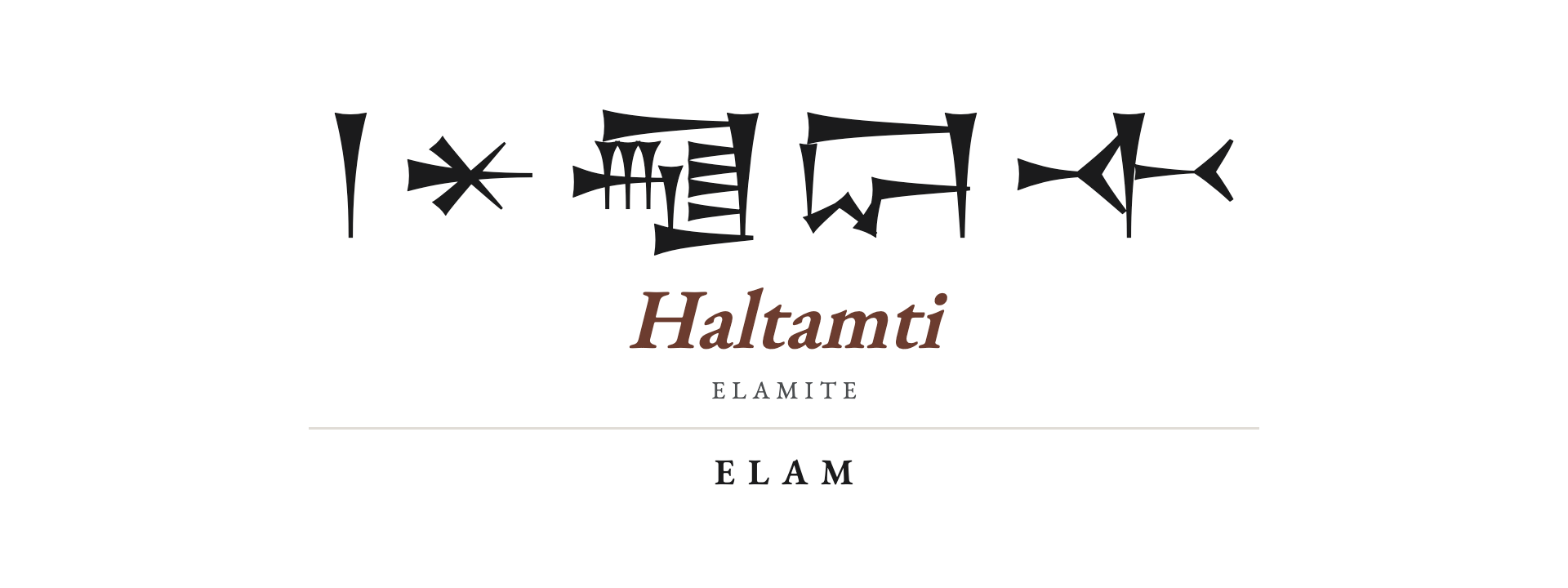
𒁹𒄬𒆷𒁶𒋾
- Transliteration
- Haltamti
- IPA
- *haltamti
- Meaning
- “the lord country”
- Confidence
- attested
The endonym for Elam, the name the Elamites gave their own country, written in cuneiform Elamite as Haltamti (earlier Linear Elamite Hatamti) and conventionally understood as “the lord country.” It runs through the royal inscriptions of the Middle and Neo-Elamite kings, who titled themselves rulers of Anšan and Susa, the highland and lowland halves of the realm. Elamite is a language isolate, connected to no other known tongue, and Haltamti shares the fate of its language: it is a name with no relatives, neither borrowed from a neighbor nor passed on to one.
Haltamti is the entry on this page with no descendants. Every other name for Elam, the Mesopotamian Elam and the Iranian Ūvja alike, is something its neighbors called it; this alone is what Elam called itself, and it died when Elamite died, leaving no trace in the names the later world used. The modern name “Elam” is the Sumerians’ word, not the Elamites’; the modern region “Khuzistan” is the Persians’. The people who built Susa and humbled Babylon and gave the Achaemenid Empire its chancery language left, of all their long history of naming, not one syllable of their own name for their own country in common use anywhere on earth today. Haltamti survives only where the cuneiform does, an endonym that outlived neither its speakers nor its script.
Sources (3)
- Potts, D. T. The Archaeology of Elam: Formation and Transformation of an Ancient Iranian State. 2nd ed. Cambridge: Cambridge University Press, 2016.
- Hinz, Walther, and Heidemarie Koch. Elamisches Wörterbuch. 2 vols. Berlin: Dietrich Reimer, 1987, s.v. Haltamti.
- Stolper, Matthew W. "Elam." In Reallexikon der Assyriologie, vol. 5.
Cite this entry
Rajagopal, Shriram. "Haltamti (Elamite name for Elam)." Onomastikon: A Digital Atlas of Ancient Names. https://onomastikon.org/civilizations/elam#elamite-haltamti.
@misc{onomastikon-elam-elamite-haltamti, author = {Rajagopal, Shriram}, title = {Haltamti (Elamite name for Elam)}, year = {2026}, howpublished = {\url{https://onomastikon.org/civilizations/elam#elamite-haltamti}}, note = {Onomastikon: A Digital Atlas of Ancient Names} }Akkadian c. 2350 BCE – 540 BCE #
𒉏𒈠𒆠
- Transliteration
- Elamtu
- IPA
- /eˈlamtu/
- Meaning
- “Elam (the highland country)”
- Derived from
- Sumerian Elam
- Confidence
- attested
The Akkadian name for Elam, Elamtu, the Semitic form built on the Sumerian Elam with the Akkadian feminine ending, written with the same NIM.MA logogram that the Sumerian scribes used and read in Akkadian as Elamtu. It runs through the whole length of Akkadian writing, from the Sargonic kings who campaigned east of the Tigris to the Neo-Assyrian annals of Ashurbanipal, whose account of the sack of Susa around 646 BCE is the fullest Mesopotamian description of the destruction of an Elamite capital, and on into the Neo-Babylonian record. The gentilic elamû, “Elamite,” is the same root.
Elamtu is the pivot through which the Sumerian highland-name became an international one. The Sumerians coined Elam, but it was Akkadian, the lingua franca of the Near East for two millennia, that carried it outward, and every Semitic and Greek form downstream reflects this Akkadian-mediated word rather than the Sumerian original directly. The same logogram served two languages, Elam on a Sumerian tongue and Elamtu on an Akkadian one, a single written sign voiced two ways, exactly as Babylon’s name was. By Ashurbanipal’s day the word named the empire’s most stubborn eastern enemy; within a century an Elamite house, the Achaemenids of Anshan, would rule everything the Assyrians had, and the old Akkadian name would pass quietly to the scribes of Persia.
Sources (2)
- Chicago Assyrian Dictionary (CAD), University of Chicago, Vol. E, s.v. elamtu, elamû.
- Stolper, Matthew W. "Elam." In Reallexikon der Assyriologie, vol. 5.
Cite this entry
Rajagopal, Shriram. "Elamtu (Akkadian name for Elam)." Onomastikon: A Digital Atlas of Ancient Names. https://onomastikon.org/civilizations/elam#akkadian-elamtu.
@misc{onomastikon-elam-akkadian-elamtu, author = {Rajagopal, Shriram}, title = {Elamtu (Akkadian name for Elam)}, year = {2026}, howpublished = {\url{https://onomastikon.org/civilizations/elam#akkadian-elamtu}}, note = {Onomastikon: A Digital Atlas of Ancient Names} }Biblical Hebrew c. 900 BCE – 100 BCE #
עֵילָם
- Transliteration
- ʿÊlām
- IPA
- /ʕeːˈlaːm/
- Meaning
- “Elam”
- Confidence
- attested
The Biblical Hebrew name for Elam, ʿÊlām, taken into Hebrew from the Mesopotamian Elam / Elamtu. It carries a double identity in the Hebrew Bible: in the Table of Nations at Genesis 10:22, Elam is the firstborn son of Shem and so the eponymous ancestor of a people, while elsewhere it is plainly the eastern kingdom, the ʿÊlām whose king Chedorlaomer leads the eastern coalition against Abraham in Genesis 14, and the nation against which Jeremiah pronounces an oracle of doom and restoration. The Elamites were not in fact a Semitic-speaking people, but the genealogists of Genesis reckoned them among the sons of Shem, placing the highland kingdom inside the family of nations they knew.
ʿÊlām is the form through which the Sumerian highland-name entered the scriptural tradition and, with it, the permanent vocabulary of the West. The same Hebrew word stands behind the Greek Ailam of the Septuagint and the Latin of the Vulgate, and it is the reason “Elam” is a familiar word in English at all: not through any classical geographer but through the Bible, where the kingdom appears as a son of Shem and a rod of God’s judgment. The Book of Daniel sets its vision by the river Ulai “in Susa, in the province of Elam,” fixing the old capital and the old name together in the scripture’s geography centuries after the Elamite kings were gone.
Sources (3)
- Hebrew and Aramaic Lexicon of the Old Testament (HALOT), Leiden: Brill, 1994–2000, s.v. ʿêlām.
- Genesis 10:22, 14:1.
- Jeremiah 49:34–39; Isaiah 21:2; Ezra 4:9.
Cite this entry
Rajagopal, Shriram. "ʿÊlām (Biblical Hebrew name for Elam)." Onomastikon: A Digital Atlas of Ancient Names. https://onomastikon.org/civilizations/elam#biblical-hebrew-elam.
@misc{onomastikon-elam-biblical-hebrew-elam, author = {Rajagopal, Shriram}, title = {ʿÊlām (Biblical Hebrew name for Elam)}, year = {2026}, howpublished = {\url{https://onomastikon.org/civilizations/elam#biblical-hebrew-elam}}, note = {Onomastikon: A Digital Atlas of Ancient Names} }Old Persian c. 520 BCE – 330 BCE #
𐎢𐎺𐎩
- Transliteration
- Ūvja
- IPA
- /ˈuːv.ja/
- Meaning
- “Elam; Susiana (the Achaemenid satrapy)”
- Confidence
- attested
The Old Persian name for Elam, Ūvja, the form by which the Achaemenid kings named the satrapy that had been the Elamite homeland. It heads the lists of subject lands in the royal inscriptions and figures in the narrative of the Behistun monument, where Darius recounts the revolts of Elam under pretenders he put down. The name is wholly unrelated to the Mesopotamian Elam: it is the Iranian designation of the territory and its people, the same root that the Greeks heard as the Ouxioi (Uxians) of the Zagros, and it belongs to a naming tradition entirely separate from the Semitic one.
Ūvja is the headwater of the name that won. Of Elam’s three traditions, the Elamite Haltamti left no descendants and the Mesopotamian Elam became a word of scripture and scholarship, but Ūvja became the living name of the land: it passed into Middle Persian as Hūz, yielding the Sasanian province Hūzestān and the Arabic al-Ahwāz, and so it is Ūvja, not Elam or Haltamti, that survives on the modern map as Khuzistan. The Persians who absorbed Elam and took Susa for their winter capital gave the country the name it still bears, a quiet linguistic conquest outlasting the political one by twenty-five centuries.
Sources (2)
- Kent, Roland G. Old Persian: Grammar, Texts, Lexicon. 2nd ed. New Haven: American Oriental Society, 1953, s.v. Ūvja-.
- Behistun inscription (DB), Old Persian version (the revolt of Elam under Āçina and Martiya).
Cite this entry
Rajagopal, Shriram. "Ūvja (Old Persian name for Elam)." Onomastikon: A Digital Atlas of Ancient Names. https://onomastikon.org/civilizations/elam#old-persian-uvja.
@misc{onomastikon-elam-old-persian-uvja, author = {Rajagopal, Shriram}, title = {Ūvja (Old Persian name for Elam)}, year = {2026}, howpublished = {\url{https://onomastikon.org/civilizations/elam#old-persian-uvja}}, note = {Onomastikon: A Digital Atlas of Ancient Names} }Imperial Aramaic c. 500 BCE – 200 BCE #
עילם
- Transliteration
- ʿylm
- IPA
- *ʕeːˈlaːm
- Meaning
- “Elam (Aramaic administrative and biblical usage)”
- Confidence
- attested
The Imperial Aramaic name for Elam, ʿylm, the cognate of Hebrew ʿÊlām, used in the Achaemenid administrative world for which Aramaic was the chancellery language. It appears in the Aramaic of the Book of Ezra, in the list of the peoples whom the Persian kings had resettled in Samaria, where “the Elamites” stand among the nations of the empire writing to the king; the same word served the imperial bureaucracy that ran, in part, from Susa, the old Elamite capital that had become an Achaemenid seat of government. The Hebrew-script form here follows scholarly convention; the original was written in the Aramaic alphabet.
Aramaic ʿylm sits at an administrative crossroads that the page’s other names do not. Susa was both the heart of historical Elam and a working capital of the Persian Empire whose paperwork was done in Aramaic, so the Aramaic name for Elam was in live bureaucratic use precisely where and when the Old Persian Ūvja was being carved into the cliff at Behistun for the same territory. Here the Semitic Elam tradition and the Iranian Ūvja tradition overlap on the ground, two names for one satrapy in two of the empire’s languages, and Aramaic carried its branch onward into the Syriac of Late Antiquity while Old Persian’s branch went to Middle Persian.
Sources (2)
- Hoftijzer, J., and K. Jongeling. Dictionary of the North-West Semitic Inscriptions. Leiden: Brill, 1995, s.v. ʿylm.
- Ezra 4:9 (Aramaic).
Cite this entry
Rajagopal, Shriram. "ʿylm (Imperial Aramaic name for Elam)." Onomastikon: A Digital Atlas of Ancient Names. https://onomastikon.org/civilizations/elam#imperial-aramaic-elam.
@misc{onomastikon-elam-imperial-aramaic-elam, author = {Rajagopal, Shriram}, title = {ʿylm (Imperial Aramaic name for Elam)}, year = {2026}, howpublished = {\url{https://onomastikon.org/civilizations/elam#imperial-aramaic-elam}}, note = {Onomastikon: A Digital Atlas of Ancient Names} }Ancient Greek c. 300 BCE – 200 CE #
Ἐλυμαΐς
- Transliteration
- Elymaís
- IPA
- /e.ly.maˈis/
- Meaning
- “Elymais (Elam)”
- Confidence
- attested
The Greek name for Elam, Elymaís, the Hellenized form of the old Semitic Elam, used for the highland country of the Zagros and the semi-independent kingdom that held it under the Seleucids and Parthians. It appears in 1 Maccabees, which reports the death of Antiochus IV at “Elymais in Persia,” and in the geographers Strabo and Polybius, who describe Elymais as a mountain realm of brigand-archers never fully tamed by the empires of the plain. Alongside it the Greeks used two other names for the region: Sousianḗ, “Susiana,” after the city of Susa, for the lowland, and the older Herodotean Kissía; Elymaís is the one that preserves the ancient name Elam itself.
Elymaís is where the Semitic Elam tradition reaches its classical, Western-facing form. The same name that the Sumerians coined and the Akkadians and Hebrews carried becomes, in Greek, the -ís of a Hellenistic toponym, and through 1 Maccabees and the geographers it entered the learned European vocabulary as the name of an ancient Iranian land. It also marks the page’s chronological hinge: by the time Greek was writing Elymaís, Elam as an independent civilization was long finished, and the word named a Parthian-era survival, a mountain principality wearing the old name, rather than the kingdom of Susa and Anshan that had once carried off the spoils of Babylon.
Sources (3)
- Liddell, Henry George, and Robert Scott. A Greek-English Lexicon (LSJ). 9th ed. Oxford: Clarendon Press, 1940, s.v. Ἐλυμαΐς, Σουσιανή.
- 1 Maccabees 6:1.
- Strabo, Geography 16.1; Polybius, Histories 31.9.
Cite this entry
Rajagopal, Shriram. "Elymaís (Ancient Greek name for Elam)." Onomastikon: A Digital Atlas of Ancient Names. https://onomastikon.org/civilizations/elam#ancient-greek-elymais.
@misc{onomastikon-elam-ancient-greek-elymais, author = {Rajagopal, Shriram}, title = {Elymaís (Ancient Greek name for Elam)}, year = {2026}, howpublished = {\url{https://onomastikon.org/civilizations/elam#ancient-greek-elymais}}, note = {Onomastikon: A Digital Atlas of Ancient Names} }Latin c. 50 BCE – 400 CE #
Elymais
- Transliteration
- Elymais
- IPA
- /eˈly.ma.is/
- Meaning
- “Elymais (Elam; toponym, from Greek)”
- Derived from
- Ancient Greek Elymaís
- Confidence
- attested
The Latin name for Elam, Elymais, taken directly from Greek Elymaís and used by the Roman geographers for the region at the head of the Persian Gulf, the mountain country behind Susiana. Pliny the Elder places Elymais among the lands of the Parthian east, describing its rivers and its position against Susiana and Persis, drawing the old highland kingdom into the Roman map of an Orient it knew mostly at second hand through Greek sources. As in Greek, Susiana serves alongside it as the name of the lowland around Susa.
Latin Elymais is the end of the Greek-via-Latin road for this name, the form in which “Elam,” by then filtered through Greek, sat in the geographical literature that medieval and modern Europe inherited. It is a fainter legacy than the Latin names for Egypt or Persia, because Elam was remote and long extinct and Rome never approached it; but it belongs to the same pattern, a Near Eastern name reaching the West in Greek dress and then Latin. The scholarly “Elymais” of modern ancient-history writing descends from this line, while the modern place on the map, Khuzistan, descends from the wholly separate Iranian name that the same territory carried at the same time.
Sources (2)
- Lewis, Charlton T., and Charles Short. A Latin Dictionary. Oxford: Clarendon Press, 1879, s.v. Elymais, Susiana.
- Pliny the Elder, Naturalis Historia 6.111, 6.135.
Cite this entry
Rajagopal, Shriram. "Elymais (Latin name for Elam)." Onomastikon: A Digital Atlas of Ancient Names. https://onomastikon.org/civilizations/elam#latin-elymais.
@misc{onomastikon-elam-latin-elymais, author = {Rajagopal, Shriram}, title = {Elymais (Latin name for Elam)}, year = {2026}, howpublished = {\url{https://onomastikon.org/civilizations/elam#latin-elymais}}, note = {Onomastikon: A Digital Atlas of Ancient Names} }Syriac c. 150 CE – 600 CE #
ܥܝܠܡ
- Transliteration
- ʿĒlām
- IPA
- /ʕeːˈlɔm/
- Meaning
- “Elam”
- Derived from
- Imperial Aramaic ʿylm
- Confidence
- attested
The Syriac name for Elam, ʿĒlām, the inherited continuation of the Aramaic ʿylm into the Aramaic dialect of Edessa that became the language of Near Eastern Christianity. It stands in the Peshitta wherever the Hebrew has ʿÊlām: among the sons of Shem in Genesis 10, in the war of the eastern kings in Genesis 14, and in Daniel’s vision set in Susa “in the province of Elam.” Syriac Christianity in fact flourished in the very region the name denotes, the lowland that the Sasanians called Hūzestān, so that the biblical ʿĒlām and the lived geography of the Church of the East lay over the same ground.
ʿĒlām is the youngest member of the Semitic Elam family and the last ancient link in its chain, the point where the Sumerian highland-name, four thousand years downstream of its coining, reaches the scriptural literature of Late Antiquity still recognizably itself. On this page it sits beside its Iranian rival in the same period: a Syriac-speaking Christian of Sasanian Mesopotamia would have known the land of the Bible as ʿĒlām and the province of the tax-collector as Hūzestān, the two great traditions for Elam’s name running in parallel through one bilingual world, neither aware it was naming what the Elamites had called Haltamti.
Sources (2)
- Payne Smith, R. Thesaurus Syriacus. Oxford: Clarendon Press, 1879–1901, s.v. ܥܝܠܡ.
- Peshitta, Genesis 10:22; Genesis 14:1; Daniel 8:2.
Cite this entry
Rajagopal, Shriram. "ʿĒlām (Syriac name for Elam)." Onomastikon: A Digital Atlas of Ancient Names. https://onomastikon.org/civilizations/elam#syriac-elam.
@misc{onomastikon-elam-syriac-elam, author = {Rajagopal, Shriram}, title = {ʿĒlām (Syriac name for Elam)}, year = {2026}, howpublished = {\url{https://onomastikon.org/civilizations/elam#syriac-elam}}, note = {Onomastikon: A Digital Atlas of Ancient Names} }Middle Persian c. 224 CE – 650 CE #
𐭤𐭥𐭦𐭮𐭲𐭠𐭭
- Transliteration
- Hūzestān
- IPA
- *huːzesˈtaːn
- Meaning
- “the land of the Hūz (Susiana; from Old Persian Ūvja)”
- Derived from
- Old Persian Ūvja
- Confidence
- attested
The Middle Persian name for the land of Elam, Hūzestān, “the land of the Hūz,” built on Hūz, the regular Middle Persian descendant of Old Persian Ūvja, with the suffix -istān. It is the Sasanian administrative name for the rich lowland province around Susa and the Karun, one of the settled heartlands of the empire, and it stands in the Pahlavi geographical tradition among the lands of Ērānšahr. The sound-change from Ūvja to Hūz is regular, and the province-name simply adds the productive Iranian suffix for a country.
Hūzestān is the name in its living, governing form, the middle term between Darius’s Ūvja and modern Khuzistan. While the Semitic Elam survived in this same period only as a word of the Bible, Hūzestān was the everyday name of a real province with real revenues, the Sasanian designation of the territory the Elamites had built. The continuity is unbroken to the present: New Persian smooths Hūz to Xūz, and the country Darius listed as Ūvja and the Sasanians taxed as Hūzestān is the Iranian province of Khuzistan today, its name a direct inheritance from the Achaemenid chancery while the kingdom’s own Haltamti has been gone for two and a half thousand years.
Sources (2)
- MacKenzie, D. N. A Concise Pahlavi Dictionary. London: Oxford University Press, 1971, s.v. Hūzestān, Hūz.
- Encyclopaedia Iranica, s.v. Ḵuzestān.
Cite this entry
Rajagopal, Shriram. "Hūzestān (Middle Persian name for Elam)." Onomastikon: A Digital Atlas of Ancient Names. https://onomastikon.org/civilizations/elam#middle-persian-huzestan.
@misc{onomastikon-elam-middle-persian-huzestan, author = {Rajagopal, Shriram}, title = {Hūzestān (Middle Persian name for Elam)}, year = {2026}, howpublished = {\url{https://onomastikon.org/civilizations/elam#middle-persian-huzestan}}, note = {Onomastikon: A Digital Atlas of Ancient Names} }Geʽez c. 350 CE – 700 CE #
ኤላም
- Transliteration
- Elam
- IPA
- /ʔeːˈlam/
- Meaning
- “Elam”
- Confidence
- attested
The Geʿez name for Elam, Elam, carried into the Christian literature of Ethiopia through the Bible. The Ethiopic Old Testament was translated from the Greek Septuagint between roughly the fourth and sixth centuries CE, and it renders the Elam of the Table of Nations, Shem’s firstborn in Genesis 10:22, as Elam. It is the farthest-flung member of the Semitic Elam family, a highland-name coined on the Sumerian plain reaching, by way of Hebrew and Greek scripture, a language and a church on the far side of the Red Sea that never had any contact with the kingdom it names.
Elam in Geʿez exists purely as a name of sacred genealogy, with no geographic or political referent in the Ethiopian world at all; it is a word the Ethiopian church possesses only because it possesses the Table of Nations. The contrast with the name’s other late branch is total. In the same centuries that Geʿez was recording Elam as an ancestor in a biblical list, Middle Persian was using Hūzestān as the live administrative name of the actual territory, taxed and governed from Ctesiphon. One branch of Elam’s naming had become pure scripture at the edge of the world, the other pure bureaucracy at its old center, and between them the country itself, under its own name Haltamti, had been forgotten by both.
Sources (2)
- Genesis 10:22 (Ethiopic Old Testament).
- Dillmann, August. Lexicon Linguae Aethiopicae. Leipzig: Weigel, 1865.
Cite this entry
Rajagopal, Shriram. "Elam (Geʽez name for Elam)." Onomastikon: A Digital Atlas of Ancient Names. https://onomastikon.org/civilizations/elam#geez-elam.
@misc{onomastikon-elam-geez-elam, author = {Rajagopal, Shriram}, title = {Elam (Geʽez name for Elam)}, year = {2026}, howpublished = {\url{https://onomastikon.org/civilizations/elam#geez-elam}}, note = {Onomastikon: A Digital Atlas of Ancient Names} }Classical Arabic c. 650 CE – 1300 CE #
الأهواز
- Transliteration
- al-Ahwāz
- IPA
- /alʔahˈwaːz/
- Meaning
- “the lands of the Hūz (Khuzistan; from the Iranian Hūz)”
- Confidence
- attested
The Classical Arabic name for the land of Elam, al-Ahwāz, the Arabic continuation of the Iranian Hūz. The form is a broken plural built on Hūz, the people and region of Susiana, the same Hūz that underlies Middle Persian Hūzestān; Arabic took the Iranian root and gave it native Arabic morphology, “the Hūz-lands.” The geographers of the Islamic world, Yāqūt among them, use al-Ahwāz for the province and its chief city on the Karun, alongside the borrowed Khūzistān, describing the sugar-cane country and canals of the old Elamite lowland.
al-Ahwāz is the Iranian name’s last ancient transformation, the point where Ūvja completes its passage through three languages: Old Persian to Middle Persian to Arabic, Ūvja to Hūz to al-Ahwāz. It belongs firmly to the Iranian tradition rather than the Semitic Elam one, even though Arabic is a Semitic language, because Arabic took the regional name from the Persians who governed the land, not from the biblical genealogies that gave it ʿĪlām. The two traditions meet once more in modern usage and divide cleanly: scholarship calls the ancient civilization “Elam,” from the Sumerian word, while the living region is “Khuzistan,” from the Persian, and the Arabic al-Ahwāz survives as the name of its principal city.
Sources (2)
- Yāqūt al-Ḥamawī. Muʿjam al-Buldān, s.v. الأهواز, خوزستان.
- The Encyclopaedia of Islam. 2nd ed. Leiden: Brill, 1960–2005, s.v. al-Ahwāz, Ḵhūzistān.
Cite this entry
Rajagopal, Shriram. "al-Ahwāz (Classical Arabic name for Elam)." Onomastikon: A Digital Atlas of Ancient Names. https://onomastikon.org/civilizations/elam#classical-arabic-ahwaz.
@misc{onomastikon-elam-classical-arabic-ahwaz, author = {Rajagopal, Shriram}, title = {al-Ahwāz (Classical Arabic name for Elam)}, year = {2026}, howpublished = {\url{https://onomastikon.org/civilizations/elam#classical-arabic-ahwaz}}, note = {Onomastikon: A Digital Atlas of Ancient Names} }Cite this page
Rajagopal, Shriram. "Elam." Onomastikon: A Digital Atlas of Ancient Names. https://onomastikon.org/civilizations/elam.
@misc{onomastikon-elam,
  author = {Rajagopal, Shriram},
  title = {Elam},
  year = {2026},
  howpublished = {\url{https://onomastikon.org/civilizations/elam}},
  note = {Onomastikon: A Digital Atlas of Ancient Names}
}Spot an error on this page? Suggest a correction →